
 +86 15853145085

 National Service Hotline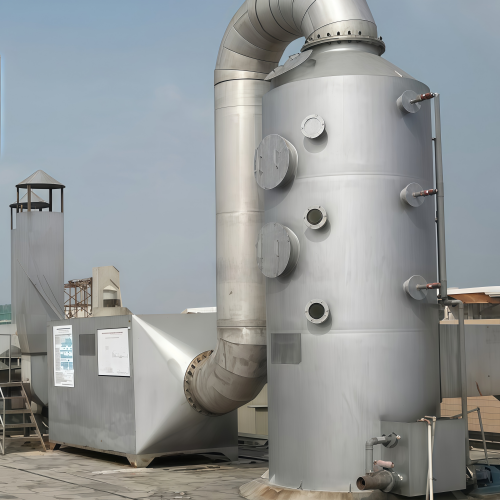
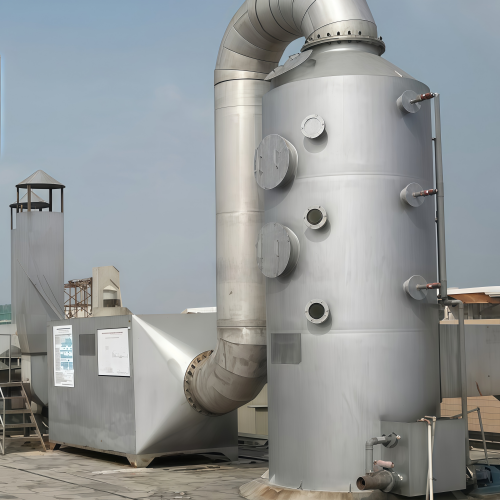
Granulation waste gas contains complex components such as dust, VOCs, acidic and alkaline gas. Spray towers are mostly used as pretreatment units and often combined with other equipment to form combined processes. The single-tower process is only applicable to simple working conditions.
1. Single-Tower Basic Treatment Process
The granulation waste gas is collected by an air collecting hood and introduced into the bottom of the spray tower. The waste gas flows upward through the internal packing layer. The top spraying system atomizes absorption liquid to form a liquid film on the packing layer. The waste gas makes full contact with the liquid film. Dust is intercepted, acidic or alkaline gas is neutralized by corresponding absorption liquid, and part of water-soluble pollutants are dissolved. Finally, the waste gas passes through a defogging layer to remove entrained droplets before discharge. The contaminated absorption liquid at the bottom flows back through the circulation system and is replaced regularly to avoid efficiency decline. This process is suitable for granulation working conditions with high-concentration dust or single acid-base waste gas.
2. Spray Tower + Activated Carbon Adsorption Combined Process
It is an economical solution commonly used in medium and small granulation factories. The spray tower removes most dust and partial soluble organic matter while reducing waste gas temperature to prevent high-temperature damage to subsequent activated carbon. The pretreated waste gas enters the activated carbon adsorption tower. Activated carbon micropores adsorb residual VOCs and odors to ensure compliant emission. This process is suitable for plastic granulation waste gas with medium and low VOCs concentration.
3. Spray Tower + RCO Catalytic Combustion Combined Process
It is applicable to working conditions with high VOCs concentration such as modified granulation. The spray tower removes dust and corrosive gas to prevent catalyst adhesion and corrosion. The pretreated waste gas is sent into the RCO device. Under catalytic action, VOCs are oxidized into carbon dioxide and water at low temperature. The system recovers reaction heat to reduce energy consumption.
4. Spray Tower + Electric Tar Precipitator Combined Process
It is suitable for granulation waste gas containing tar and viscous organic matter. Sodium hydroxide or sulfuric acid solution is used as absorption liquid in the spray tower to remove sulfides and other pollutants. After preliminary purification, the waste gas enters the electric tar precipitator. Tar droplets and fine oil-soluble particles are captured by a high-voltage electrostatic field to avoid subsequent equipment blockage and ensure exhaust cleanliness.
5. Spray Tower + Bag Dust Collector + Adsorption Combined Process
This process is designed for granulation working conditions with extremely high dust content. The waste gas firstly passes through the spray tower to remove large particles and acidic gas, then enters the bag dust collector for fine dust removal. Finally, residual low-concentration VOCs are treated by activated carbon or zeolite rotor. This combination adapts to large-air-volume waste gas with composite pollutants and is suitable for large-scale granulation production lines.
Granulation waste gas contains pollutants such as particulate matter, VOCs and odor. National standards are adopted as the main basis, while stricter local standards are implemented in some regions.
1. Core National Standards
GB 31572-2015: Emission Standard of Pollutants for Synthetic Resin Industry (including 2024 amendment). It is the core standard for most plastic granulation factories, specifying emission limits of organized particulate matter and non-methane hydrocarbons, as well as unorganized boundary concentration limits. Special emission limits are required in some regions.
GB 37822-2019: Volatile Organic Compounds Emission Control Standard for Non-Organized Emission. It controls unorganized VOCs in the factory area and specifies concentration limits for monitoring points outside workshops.
GB 14554-1993: Odor Pollutant Emission Standard. It regulates odor concentration generated by heating and material degradation, including organized emission limits and secondary unorganized boundary limits.
GB 16297-1996: Comprehensive Emission Standard of Atmospheric Pollutants. It is mainly used for dust control in crushing processes and serves as the basic guarantee standard for particulate matter treatment.
2. Typical Local Supplementary Standards
Jiangxi (DB36/1101.4-2019): Discharge Standard of Volatile Organic Compounds — Part 4: Plastic Products Industry. Exclusive VOCs emission limits are formulated for plastic granulation waste gas. Local enterprises shall comply with stricter requirements in case of conflicts with national standards.
Jiangsu (DB32/4041-2021): Comprehensive Atmospheric Pollutant Emission Standard. It refines unorganized emission limits of particulate matter and non-methane hydrocarbons inside the factory.
Guangdong (DB44/2367-2022): Comprehensive Emission Standard for VOCs from Stationary Pollution Sources. It specifies VOCs limits and cooperates with DB44/27-2001 to control particulate matter and hydrogen chloride. Some indicators require 50% stricter emission rate.
Temperature Drop Analysis of Spray Tower
The temperature drop range of waste gas treated by spray towers is not fixed. It is mainly affected by inlet temperature, spray liquid temperature and gas-liquid ratio. The conventional temperature drop is 10~40℃, and it can exceed 50℃ under extreme conditions.
1. Core Influencing Factors
Inlet gas temperature: High-temperature waste gas (100-200℃) has a temperature drop of 30~50℃; medium and low-temperature waste gas (40-80℃) drops by 10~20℃.
Spray liquid temperature: Lower liquid temperature brings better cooling effect. Normal temperature clean water (20-30℃) is commonly used. Low-temperature cooling liquid (10-15℃) can increase the temperature drop by 5~10℃.
Gas-liquid ratio: A higher ratio means sufficient gas-liquid contact. The conventional ratio is 1~3 L/m³. Doubling the ratio increases cooling range by 10~15℃.
Spray mode: Countercurrent spraying is 5~10℃ more efficient than concurrent spraying. Fine atomization increases contact area and improves cooling performance.
Gas humidity: Dry gas (relative humidity <30%) has larger temperature drop due to water evaporation and heat absorption. High-humidity gas (relative humidity >80%) reduces cooling range by 5~10℃.
2. Typical Working Condition Cases
Plastic granulation high-temperature waste gas: Inlet temperature 120-150℃, normal temperature water, gas-liquid ratio 2 L/m³, temperature drop 30~40℃, outlet temperature 80-110℃.
Chemical acid-base waste gas: Inlet temperature 60-80℃, normal temperature water, gas-liquid ratio 1.5 L/m³, temperature drop 15~25℃, outlet temperature 40-65℃.
Boiler flue gas pretreatment: Inlet temperature 180-200℃, cooling spray liquid (15℃), gas-liquid ratio 3 L/m³, temperature drop 50~60℃, outlet temperature 120-150℃.
3. Precautions
Excessive temperature reduction may cause water vapor condensation, resulting in tower corrosion and packing blockage.
Temperature control devices or multi-stage spraying can be installed for precise outlet temperature control.
Low temperature shall be avoided for high-concentration VOCs waste gas to prevent condensation adhesion and potential safety hazards.