
 +86 15853145085

 全国服务热线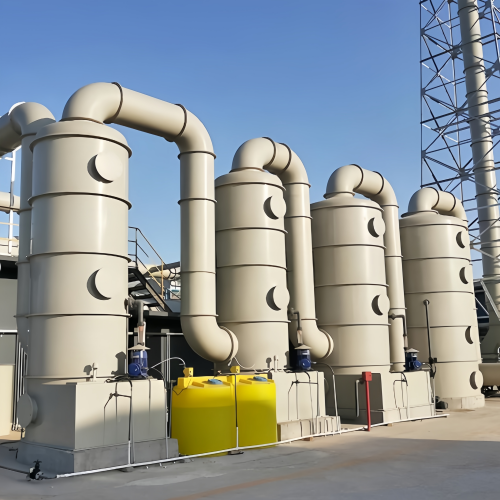
1. Core Functions
Absorb acidic and alkaline waste gas (such as HCl, SO₂, NH₃) and reduce corrosivity by neutralization.
Capture particulate matter such as dust and mist droplets to reduce atmospheric dust pollution.
Remove partial organic waste gas (VOCs) and control odor diffusion.
2. Main Applications
Chemical Industry: Treat acidic tail gas, alkaline waste gas and organic volatile substances generated by chemical reactions.
Electroplating Industry: Purify acid mist (chromic acid mist, hydrochloric acid mist) volatilized from electroplating tanks to protect operators.
Coating Industry: Absorb paint mist and VOCs generated during spraying to reduce peculiar odor.
Metallurgical Industry: Treat sulfur-containing waste gas and dust from smelting to reduce air pollution.
Electronic Industry: Purify acidic waste gas produced by semiconductor manufacturing and circuit board etching.
Pharmaceutical Industry: Treat organic waste gas and corrosive gas generated in drug synthesis.
Sewage Treatment Plant: Remove odorous gas such as hydrogen sulfide and ammonia from aeration tanks and sludge treatment areas.
Boiler Flue Gas Treatment: Complete desulfurization and dust removal pretreatment to ensure flue gas compliance.
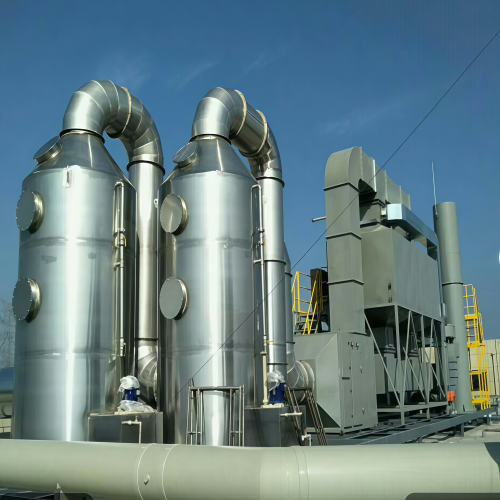
Application Scope of Spray Tower
1. Applicable Pollutant Types
Acid and Alkaline Gas: Hydrochloric acid mist, sulfuric acid mist, nitrogen oxides, ammonia and alkaline tail gas.
Particulate Matter: Industrial dust, paint mist, liquid droplets and smoke.
Organic Waste Gas: Partial VOCs and odorous gas (hydrogen sulfide, methyl mercaptan).
Other Functions: High-temperature flue gas cooling pretreatment and gas humidification.
2. Applicable Industries
Chemical & Petrochemical Industry: Treat acid-base tail gas and organic volatile substances.
Electroplating & Surface Treatment Industry: Purify corrosive gas such as acid mist and chromium mist.
Spraying & Coating Industry: Capture paint mist and remove spraying VOCs and odor.
Metallurgy & Steel Industry: Complete desulfurization and dust removal for smelting flue gas.
Electronic & Semiconductor Industry: Treat acidic waste gas from etching and cleaning processes.
Pharmaceutical & Pesticide Industry: Purify organic and corrosive gas from synthetic reactions.
Environmental Protection Field: Odor treatment for sewage plants and garbage transfer stations.
Energy & Boiler Industry: Flue gas desulfurization, cooling and dust removal.
Printing & Packaging Industry: Remove VOCs and odor volatilized by ink.
Food Processing Industry: Eliminate oil fume and peculiar smell during production.
Classification of Spray Tower Treatment Processes
1. Classification by Treatment Principle
1.1 Acid and Alkaline Waste Gas Spray Tower
1.2 Physical Absorption Process
1.3 Oxidation-Reduction Process
1.4 Combined Adsorption-Absorption Process
2. Classification by Gas-Liquid Contact Mode
2.1 Counter-current Spray Process
2.2 Co-current Spray Process
2.3 Cross-flow Spray Process
3. Classification by Special Functions
3.1 Desulfurization Spray Process
3.2 Paint Mist Capture Process
3.3 Deodorization Spray Process
3.4 Cooling Pretreatment Process
Detailed Structure of Spray Tower Demister
1. Core Structural Components
1.1 Demisting Element (Core Collection Part)
Baffle Type: Assembled by multiple wave-shaped or folded plates with diversion grooves at a specific angle. When waste gas passes through the channel, mist droplets collide with the plate wall due to inertia, attach to the surface and flow down. It has simple structure and low resistance, suitable for medium and low-concentration mist.
Wire Mesh Type: Woven by multi-layer metal or plastic wires to form a porous mesh structure. Fine mist droplets are intercepted by mesh fibers and condensed into large droplets. It owns high collection efficiency for tiny droplets but is easy to block and requires regular cleaning.
Honeycomb Type: Composed of hexagonal honeycomb channels with smooth inner walls. Mist droplets collide and settle on the wall. It features compact structure and high compression resistance, suitable for high-flow working conditions.
1.2 Support Structure
Support Beam: Arranged horizontally or longitudinally, generally made of anti-corrosion carbon steel, stainless steel or FRP with sufficient structural strength.
Fixing Bracket: Connected with the tower body to firmly fix demisting elements and avoid displacement and deformation.
1.3 Liquid Collection and Discharge System
Liquid Collection Tank: Installed under demisting elements to receive falling droplets with a slope for liquid convergence.
Liquid Guide/Return Pipe: Transports collected liquid back to the circulating water tank for recycling and waste reduction.
1.4 Flushing System (Optional for Blockage-prone Conditions)
Flushing Pipe: Arranged above demisting elements and equipped with spray nozzles.
Flushing Pump and Valve: Regularly spray clean water to remove scale and sediment on the demister and prevent blockage.
1.5 Tower Connection Structure
2. Key Structural Design Parameters
Channel Flow Velocity: A reasonable flow velocity is required. Low velocity leads to low collection efficiency, while excessive velocity causes secondary entrainment of droplets.
Baffle Angle / Mesh Layers: The baffle angle is generally 30°-60°. More mesh layers bring higher efficiency but greater airflow resistance.
Liquid Discharge Slope: The slope of the liquid collection tank is usually 3°-5° to ensure rapid liquid discharge and avoid liquid accumulation.
Material Selection: FRP and PP are commonly used for acidic waste gas; stainless steel is applied for high-temperature working conditions.
3. Typical Installation Position
Types, Functions and Replacement Cycle of Spray Tower Packing
As the core gas-liquid mass transfer component, tower packing is classified by material and structure as follows:
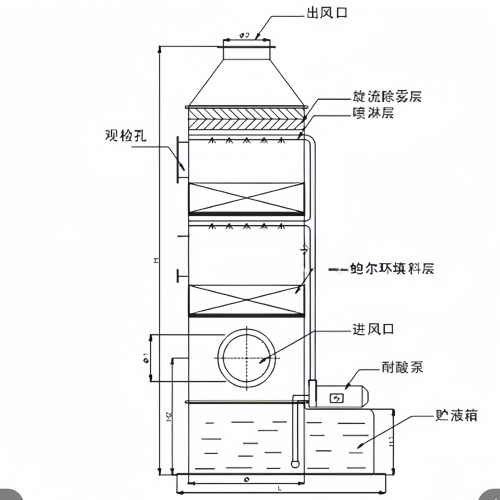
1. Types and Characteristics of Packing
1.1 Classification by Material
Plastic Packing: Made of PP, PE, PVC, etc. It features acid and alkali resistance, light weight and low cost. Suitable for medium and low temperature (≤80℃) acid-base waste gas. Common types include pall ring, raschig ring and cascade ring.
Ceramic Packing: Resistant to high temperature (≤1000℃) and strong corrosion with smooth liquid-adhering surface. Suitable for high-temperature and strongly corrosive waste gas. It is brittle and heavy, requiring careful transportation and installation. Typical products include ceramic pall ring and saddle ring.
Metal Packing: Made of stainless steel or anti-corrosion carbon steel. It has high strength, high temperature resistance and large flux, suitable for high-pressure and high-temperature working conditions such as flue gas desulfurization. It has poor corrosion resistance and high cost. Common types are metal pall ring and wire mesh corrugated packing.
1.2 Classification by Structure
Random Packing: Stacked independently in single particles, such as pall ring, raschig ring and cascade ring. It is easy to assemble and disassemble, applicable to small and medium-sized spray towers.
Structured Packing: Arranged in regular shapes such as corrugated packing and honeycomb packing. It realizes uniform gas-liquid distribution and high mass transfer efficiency for large-scale high-efficiency treatment, while it is difficult to clean after blockage.
2. Core Functions of Packing
Expand Contact Area: The porous and special geometric structure greatly increases the contact area between spray liquid (liquid phase) and waste gas (gas phase) for mass transfer reaction.
Prolong Contact Time: Disturb the gas and liquid flow path, slow down the flow speed and extend the reaction time to improve pollutant removal efficiency.
Uniform Gas-Liquid Distribution: Avoid channel flow and wall flow to ensure consistent treatment effect in all areas of the tower.
Strengthen Mass Transfer Efficiency: Optimize gas-liquid contact state, accelerate pollutant transfer from gas phase to liquid phase, improve reaction rate and reduce outlet waste gas concentration.
3. Replacement Cycle and Judgment Standard
3.1 Conventional Replacement Cycle
Random Plastic Packing: 1-3 years, depending on corrosion degree and blockage condition.
Ceramic Packing: 3-5 years with high temperature and corrosion resistance; avoid breakage during operation.
Metal Packing: 2-4 years; shortened to 1-2 years for corrosive waste gas.
Structured Packing: 2-3 years; shortened to 6-12 months for waste gas with high dust concentration due to easy blockage.
3.2 Replacement Judgment Criteria
Decreased Treatment Efficiency: The outlet waste gas concentration exceeds the standard continuously, which cannot be improved even after adjusting spray liquid concentration and flow.
Increased Pressure Loss: The internal tower pressure difference exceeds 1.5 times the design value, causing obvious fan overload.
Abnormal Packing Condition: Severe scaling, blockage, collapse and breakage, or uncleanable surface pollutants.
Poor Spraying Effect: Uneven liquid distribution caused by packing blockage leads to local dry areas inside the tower.
3.3 Influencing Factors of Service Life
Waste Gas Property: High-concentration, high-humidity and viscous pollutants accelerate packing blockage and corrosion.
Spray Liquid Quality: Excessive reagent concentration and impurities cause packing scaling.
Maintenance Frequency: Regular cleaning and backflushing prolong service life; otherwise, the service life will be shortened.
Difference Between Positive Pressure and Negative Pressure Spray Tower
1. Core Difference: Pressure State and Gas Flow Logic
1.1 Positive Pressure Spray Tower
1.2 Negative Pressure Spray Tower
2. Comparison of Key Characteristics
Comparison Dimension | Positive Pressure Spray Tower | Negative Pressure Spray Tower |
|---|---|---|
Sealing Requirement | Low (basic sealing is enough) | High (strict sealing to prevent air infiltration) |
Gas Leakage Risk | Low (leakage outward and easy to detect) | Low to Medium (air infiltration reduces purification efficiency) |
Fan Position | Front end (air supply side) | Rear end (exhaust side) |
Fan Corrosion Risk | High (contact with untreated waste gas) | Low (contact with purified clean gas) |
Applicable Waste Gas | Low-concentration, non-corrosive, non-flammable gas | High-concentration, corrosive, flammable and odorous gas |
Operation Stability | Affected by air pressure with fluctuating air volume | Stable negative pressure with flexible air volume adjustment |
3. Application Selection Suggestions
3.1 Selection for Positive Pressure Tower
3.2 Selection for Negative Pressure Tower
4. Supplementary Notes
For positive pressure towers, the front-end fan requires anti-corrosion protection. Anti-corrosion fans or pretreatment devices shall be equipped for corrosive waste gas.
Sealing performance is critical for negative pressure towers. Reinforce the tightness of tower body, pipelines and flanges to avoid efficiency reduction caused by air leakage.
Both towers share the same purification principle (gas-liquid contact and pollutant absorption), differing only in power and pressure design for flexible selection according to waste gas characteristics.
Respective Application Scenarios of Positive and Negative Pressure Spray Towers
1. Conclusion
2. Application Scenarios of Positive Pressure Spray Tower
2.1 Waste Gas Characteristics
2.2 Typical Industries & Processes
Purification of dust and cutting oil mist in mechanical processing workshops;
Slight odor treatment in food processing and packaging industries;
Purification of non-corrosive dust (plastic dust, welding smoke) in electronic factories;
Low-concentration paint mist pretreatment for small coating workshops.
2.3 On-site Requirements
3. Application Scenarios of Negative Pressure Spray Tower
3.1 Waste Gas Characteristics
3.2 Typical Industries & Processes
Treatment of acid mist and cyanide-containing waste gas in chemical and electroplating industries;
Purification of coke oven flue gas and sulfur-containing/nitrogen-containing waste gas in coking and metallurgical industries;
Treatment of high-concentration VOCs and toxic gas in pharmaceutical and chemical synthesis industries;
Treatment of high-concentration paint mist and solvent waste gas (toluene, xylene) in coating and printing industries;
Odor purification (hydrogen sulfide, ammonia) in garbage disposal and sewage treatment plants.