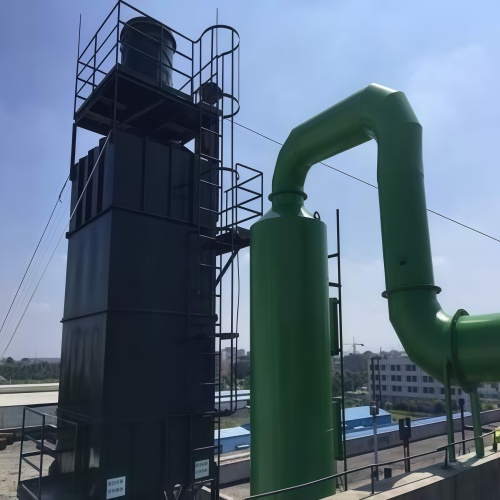
The core technology of wet electrostatic precipitator (WESP) for kiln flue gas after desulfurization and denitrification combines high-voltage electrostatic adsorption with water film ash cleaning. Aiming at the characteristics of kiln flue gas such as high temperature, complex dust composition, high humidity and strong acidity, the equipment performs terminal advanced purification to ensure qualified discharge of particulate matter, acid mist and other pollutants. The specific working principle and process are described as follows:
I. Core Working Principle
1. Flue Gas Pre-treatment and Uniform Distribution
After denitrification (SCR/SNCR) and desulfurization (FGD), the kiln flue gas is firstly cooled down to 40-60℃ by cooling devices to adapt to the operating conditions of WESP. Then the flue gas passes through a high-efficiency demister to remove large-size fog droplets (concentration ≤50mg/m³). Finally, the gas evenly enters the electric field through a flow distribution plate to avoid collection failure caused by uneven local flow velocity.
2. High-voltage Ionization and Particle Charging
A high-voltage power supply (60-100kV DC high voltage) supplies power to high-discharge-intensity thorn cathode wires, while anode plates or tubes (honeycomb/plate type) are grounded to form a strong electric field. Gas molecules in the electric field are ionized into electrons and positive ions. Electrons collide with PM2.5, SO₃ acid mist, heavy metals (Hg, Pb) and desulfurization slurry droplets in the flue gas to charge the pollutants negatively.
3. Electrostatic Adsorption and Collection
Under the action of electric field force (Coulomb force), negatively charged pollutant particles move towards the anode and adhere to the anode surface to form a pollutant film, preventing pollutant escape with flue gas.
4. Water Film Ash Cleaning and Gas Discharge
The top spray system continuously sprays clean water (or reused desulfurization wastewater) to form a uniform water film on the anode surface, which flushes pollutants into the water tank at the bottom. The purified flue gas (particulate matter ≤5mg/m³) is discharged through the chimney up to standard. The polluted wastewater is delivered to the desulfurization wastewater treatment system for centralized disposal.
II. Typical Technological Process
1. Process Positioning
As a terminal advanced treatment equipment for kiln flue gas, the WESP is installed after the denitrification reactor and desulfurization tower to remove fine pollutants that cannot be eliminated by previous processes. It is especially suitable for high-temperature kilns such as cement kilns, glass kilns and ceramic kilns.
2. Complete Process Flow
Kiln flue gas → Waste heat recovery device (cool down to below 200℃) → Denitrification reactor (SCR/SNCR, NOx removal) → Pre-duster (electrostatic fabric/bag dust collector for coarse particle removal) → Desulfurization tower (FGD, SO₂ removal) → High-efficiency demister (large fog droplet removal) → Wet electrostatic precipitator (advanced purification) → Induced draft fan → Chimney discharge
3. Exclusive Process Design for Kiln Working Conditions
Enhanced Pre-treatment: Due to the large fluctuation of dust concentration in kiln flue gas, a front-mounted electrostatic fabric dust collector is applied to control the inlet dust concentration below ≤30mg/m³, preventing electrode scaling and blockage of WESP.
Optimized Electric Field Configuration: 3-4 electric fields are connected in series with a single electric field voltage of 60-80kV, achieving a total purification efficiency ≥99.9% to adapt to complex pollutant components in kiln flue gas.
Customized Spray System: Wear-resistant fan-shaped nozzles are adopted with spray pressure of 0.3-0.5MPa. A combined mode of continuous spraying and regular high-pressure flushing is applied aiming at viscous dust in kiln flue gas to prevent anode scaling.
Upgraded Corrosion-resistant Materials: Anode plates/tubes are made of 2205 duplex stainless steel or FRP (fiberglass reinforced plastic) to adapt to acidic wet flue gas after kiln desulfurization and extend equipment service life.
III. Adaptation Advantages for Kiln Working Conditions
Strong Anti-fluctuation Capacity: The equipment can withstand kiln load fluctuation ranging from 50% to 110%, maintaining stable purification efficiency under fluctuating flue gas temperature and pollutant concentration.
Excellent Synergistic Purification Effect: It synchronously removes PM2.5, acid mist, heavy metals and desulfurization slurry droplets, completely eliminating white smoke plume and meeting strict standards such as GB 4915-2013 Emission Standard of Air Pollutants for Cement Industry.
High Temperature and Corrosion Resistance: Optimized by pre-treatment, the equipment adapts to kiln flue gas characteristics, avoiding electrode damage caused by high temperature and equipment corrosion by acidic flue gas, with a service life of more than 15 years.

 +86 15853145085

 全国服务热线