
 +86 15853145085

 全国服务热线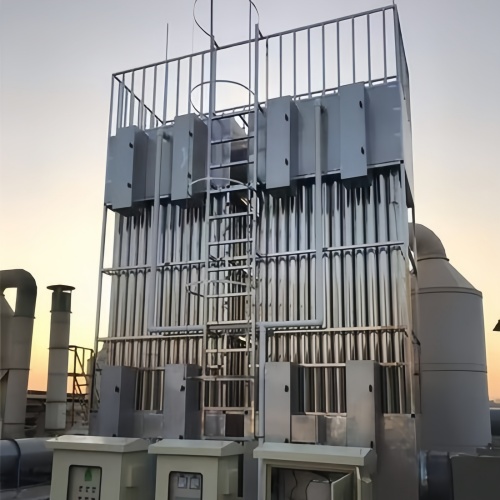
1. Flue Gas Characteristics and Treatment Challenges of Aluminum Alloy Quenching Process
1.1 Characteristics of Aluminum Alloy Quenching Process
Solution Heat Treatment: The aluminum alloy is heated to 450-550℃ and kept warm for more than 2 hours to fully dissolve alloy elements such as Cu and Mg.
Rapid Cooling: Water quenching (60-100℃ water) or oil quenching is adopted to form supersaturated solid solution and improve the strength and hardness of aluminum alloy products.
1.2 Flue Gas Characteristics
High Temperature and High Humidity: The flue gas temperature ranges from 80℃ to 120℃, containing a large amount of water vapor generated by quenching water evaporation.
- Complex Components:
Oil Mist: Evaporated quenching oil with a particle size of 0.1-10μm and strong viscosity.
Metal Oxides: Ultra-fine particles such as Al₂O₃ (0.01-200μm).
Fluorides: Fluoride-containing water vapor, especially generated during water quenching.
VOCs: Organic compounds volatilized from quenching oil.
Flammable and Explosive Risk: Aluminum dust mixed with air can form explosive mixtures.
1.3 Traditional Treatment Difficulties
Dry dust removal equipment is easy to be blocked and requires frequent maintenance.
Common filters have low purification efficiency for strongly viscous oil mist.
Ultra-fine particles such as PM2.5 are difficult to remove.
There is potential explosion risk during operation.
2. Core Working Principle: Synergistic Mechanism of High-voltage Static Electricity and Water Film Ash Cleaning
2.1 High-voltage Ionization and Particle Charging Stage
Electric Field Establishment: A high-voltage DC power supply (60-100kV) supplies power to cathode wires (thorn wires / star wires), while the anode is grounded to form a strong electric field (≥30kV/cm).
Gas Ionization: Gas molecules are ionized in the strong electric field to generate a large number of electrons and positive ions.
Particle Charging: Electrons collide with oil mist and particulate matter in flue gas to charge pollutants negatively.
2.2 Electrostatic Adsorption and Collection Stage
Directional Migration: Negatively charged particles move toward the anode (collecting electrode) under the action of electric field force (Coulomb force).
High-efficiency Capture: Even ultra-fine particles of 0.01μm can be adsorbed with a collection efficiency ≥99%.
Synergistic Removal: Oil mist, particulate matter and partial VOCs are captured simultaneously.
2.3 Water Film Ash Cleaning and Discharge Stage
Continuous Water Film: The top spray system (0.3-0.5MPa) forms a uniform water film on the anode surface.
Automatic Ash Cleaning: Pollutants are flushed into the liquid collection tank at the bottom to avoid secondary dust re-entrainment.
Purified Discharge: The treated flue gas (particulate matter ≤5mg/m³) is discharged up to standard.
Wastewater Treatment: Oily wastewater is treated and recycled with a reuse rate ≥90%.
3. Complete Technological Process: Systematic Scheme of Pre-treatment + WESP + Post-treatment
3.1 Pre-treatment System (Key Front-end Device)
3.1.1 Cooling and Humidity Conditioning
Heat Exchanger: Cool the flue gas from 80-120℃ to 40-60℃, the optimal operating temperature for WESP.
Spray Tower: Realize humidification and cooling to ensure saturated flue gas humidity and improve dust removal efficiency.
3.1.2 Oil and Large Particle Removal
Cyclone Separator: Remove large particles above 10μm with a removal efficiency of 60-80%.
Venturi Scrubber: The liquid-gas ratio is 1.5L/m³. High-speed airflow mixes with water mist to capture oil mist and coarse particles.
3.1.3 Special Treatment for Aluminum Alloy Characteristics
Alkali Spray: Adopt 8-12% NaOH solution to remove acidic gas such as HF, reducing HF concentration to 10-20mg/m³.
Conditioner Addition: Adjust flue gas conductivity to improve particle charging efficiency.
3.2 Main Process of Wet Electrostatic Precipitator
3.2.1 Electric Field Configuration
Multi-stage Series Connection: 2-3 electric fields with independent power supplies for each stage, achieving a total purification efficiency ≥99.9%.
Anode Structure: Honeycomb tubular structure (anti-blocking, suitable for high oil mist working conditions); plate structure (easy maintenance). Anode materials include 316L stainless steel, FRP and titanium alloy.
Cathode Design: Titanium alloy thorn wire with high discharge intensity and excellent corrosion resistance.
3.2.2 Spray and Ash Cleaning System
Continuous Spraying: Maintain 0.3-0.5MPa to form stable water film and prevent plate scaling.
Regular High-pressure Flushing: 0.8-1.2MPa high-pressure water is used to remove stubborn attachments.
Spiral Nozzles: Achieve full coverage without dead zones to ensure thorough ash cleaning effect.
3.2.3 Airflow Optimization
Flow Distribution Plate: Ensure uniform flue gas velocity (≤2.8m/s) with residence time ≥2s.
Deflector Blades: Reduce airflow turbulence and improve particle capture efficiency.
3.3 Post-treatment and Circulation System
Secondary Demisting: Mechanical demisting device reduces water vapor entrainment in discharged flue gas.
Wastewater Treatment: Adopt oil separation tank and air flotation to realize oil-water separation; the purity of recovered quenching oil can reach 90%. Automatic pH adjustment and flocculation sedimentation are applied, and the circulating water reuse rate is ≥90%.
Sludge Treatment: Dewatered dry sludge is safely disposed, and metal elements are recycled.
4. Special Process Parameters for Aluminum Alloy Quenching
Parameter Category | Parameter Item | Recommended Value | Function |
Flue Gas Conditions | Inlet Gas Temperature | 40-60℃ | Prevent electric field breakdown and condensation corrosion |
Inlet Pollutant Concentration | ≤50mg/m³ (After pretreatment) | Protect WESP and extend cleaning cycle | |
Flue Gas Flow Velocity | ≤2.8m/s | Ensure residence time ≥2s to improve capture efficiency | |
Electric Field Parameters | Electric Field Stages | 2-3 stages | Improve removal efficiency of fine particles |
Single-stage Voltage | 60-80kV | Ensure effective ionization and particle charging | |
Plate Spacing | 200-300mm | Prevent discharge breakdown and ensure collection efficiency | |
Spray System | Continuous Spray Pressure | 0.3-0.5MPa | Form uniform water film |
Flushing Pressure | 0.8-1.2MPa | Remove scaling deposits | |
Material Selection | Anode Plate | 316L Stainless Steel / FRP / Titanium Alloy | Resist acid and alkali corrosion and oil adhesion |
Cathode Wire | Titanium Alloy Thorn Wire | High strength, corrosion resistance and stable discharge performance | |
Insulator | Quartz Ceramic with Heating Protection | Prevent condensation creepage and ensure high-voltage safety | |
Performance Indicators | Dust Removal Efficiency | ≥99% (Particulate Matter) | Ensure outlet emission ≤5mg/m³ |
Oil Mist Removal Efficiency | ≥95% | Eliminate blue smoke plume | |
Fluoride Removal Efficiency | ≥85% | Reduce harmful gas emission |
5. Adaptation Advantages for Aluminum Alloy Quenching Process
High-efficiency Oil Mist Removal: The quenching oil mist removal rate exceeds 95%, which is far better than traditional filtration equipment.
Anti-adhesion Design: Continuous water film cleaning solves the problem of oil mist adhesion on plates and avoids equipment failure.
Safety and Explosion-proof Performance: Wet operation eliminates electric spark risks, which is suitable for flammable and explosive flue gas containing aluminum dust. Water mist reduces dust concentration and inhibits explosion hazards.
Resource Recycling: About 12 tons of quenching oil can be recycled every year with an economic value of approximately 150,000 RMB. The water circulation utilization rate exceeds 90% to save water resources.
Strong Synergistic Treatment Capacity: It simultaneously removes PM2.5, oil mist, fluorides and partial VOCs, eliminates blue smoke plume caused by oil mist condensation and improves the factory operating environment.
6. Application Case: Flue Gas Treatment for Automobile Hub Quenching
6.1 Project Overview
Treatment Object: 7075 aluminum alloy hub quenching flue gas (oil quenching).
Treatment Air Volume: 30,000m³/h.
Original Pollutant Concentration: Oil mist and dust ≈120mg/m³, containing a small amount of fluorides.
Process Route: Gas collection hood → Pipeline → Cyclone separation → Venturi scrubber → WESP → Demister → Induced draft fan → Chimney.
6.2 Core Operating Parameters
WESP Configuration: 2 electric fields with single-stage voltage of 70kV, honeycomb titanium alloy anode.
Spray Mode: Continuous spraying at 0.4MPa + regular flushing at 1.0MPa every 8 hours.
6.3 Treatment Effect and Benefit
Outlet Concentration: Particulate matter ≤3mg/m³, no detectable oil mist.
Economic Benefit: Approximately 18 tons of quenching oil are recycled every year with an economic value of about 220,000 RMB. The circulating water consumption is reduced by 70%, saving about 80,000 RMB in water fees annually.