
 +86 15853145085
The structural design of the spray tower is the key to efficient waste gas treatment. Spray towers generally adopt a multi-layer spraying structure, and each layer is equipped with multiple nozzles to ensure even liquid coverage. This design increases the gas-liquid contact area and improves the removal efficiency of harmful pollutants. In addition, packing layers are installed inside the tower. High-quality packing materials possess strong adsorption performance and large specific surface area to fully capture contaminants. The packing material and structure must also meet corrosion resistance and high-temperature resistance requirements for stable operation under harsh industrial conditions.
In addition to structural optimization, spray towers adopt advanced purification technologies. The spraying system atomizes liquid evenly to achieve full gas-liquid contact. Harmful substances in waste gas are absorbed and dissolved by the circulating liquid to complete purification. Furthermore, spray towers integrate physical, chemical and biological purification methods to enhance treatment performance. For example, some spray towers apply biofilm technology to decompose pollutants into harmless substances through microorganisms.
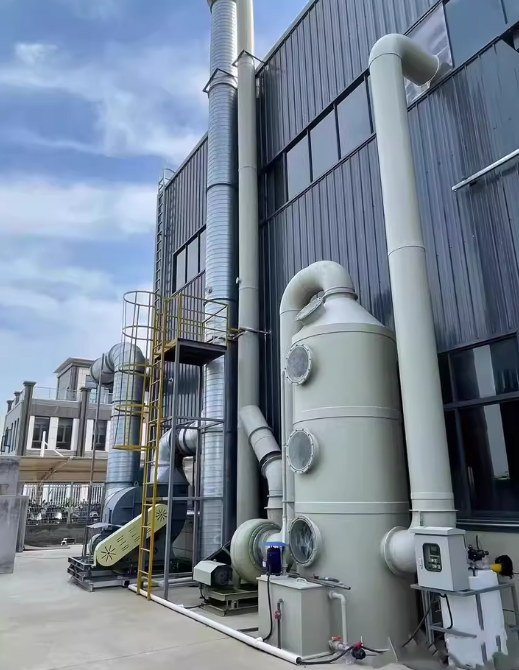
Thanks to excellent purification performance, spray towers are widely used in various industries, including chemical manufacturing, food processing, pharmaceuticals, petroleum, machinery, laboratories, metallurgy, light industry and new energy industries. The equipment can treat electroplating waste gas, pickling hydrochloric acid gas, hydrogen sulfide gas, chlorine dioxide gas and coating exhaust gas. It is also capable of removing volatile organic compounds (VOCs) to improve air quality and protect the ecological environment.
Spray towers have prominent advantages such as high purification efficiency, simple structure, convenient installation and easy maintenance. The modular design simplifies the installation process. Daily maintenance only requires regular inspection and replacement of wearing parts such as packing and nozzles to maintain stable operation. Moreover, spray towers have lower manufacturing costs, which reduces the investment pressure of enterprise waste gas treatment.
Nevertheless, spray towers have certain limitations. The treatment capacity is restricted when dealing with high-concentration and high-temperature waste gas. Purification efficiency is easily affected by gas composition, concentration and temperature, requiring personalized optimization in actual application. In addition, secondary pollution may occur during operation, and targeted prevention measures are necessary.
Researchers are continuously upgrading spray tower technologies to improve stability and purification performance. Optimization methods include upgrading packing structure and adsorption performance, introducing photocatalysis and ozone oxidation technologies, and strengthening daily maintenance management to maintain stable treatment efficiency.
In conclusion, the sophisticated structure and advanced purification technology enable spray towers to perform excellently in industrial waste gas treatment. With unique structural design and reliable purification principles, spray towers effectively eliminate air pollutants and protect environmental safety and human health. With continuous technological innovation, spray towers will play an increasingly important role in the industrial environmental protection industry.