
 +86 15853145085
A spray tower, also known as a scrubber or water washing tower, is a gas-liquid reaction device. Its working principle is to fully mix waste gas with liquid. Depending on the solubility and chemical reaction between pollutants and liquid, the equipment reduces gas concentration and removes harmful substances. A typical spray tower consists of a tower body, circulating liquid system, packing layer, atomization layer and spraying layer. Among all components, dry spray nozzles are critical for sufficient gas-liquid contact.
Driven by the fan unit, waste gas is sucked into the tower and flows through the packing layer. The gas makes contact with the flowing liquid attached to the packing surface. Harmful contaminants are removed through physical adsorption, dissolution and chemical reactions. Finally, the purified gas is discharged from the tower top to complete the purification process.
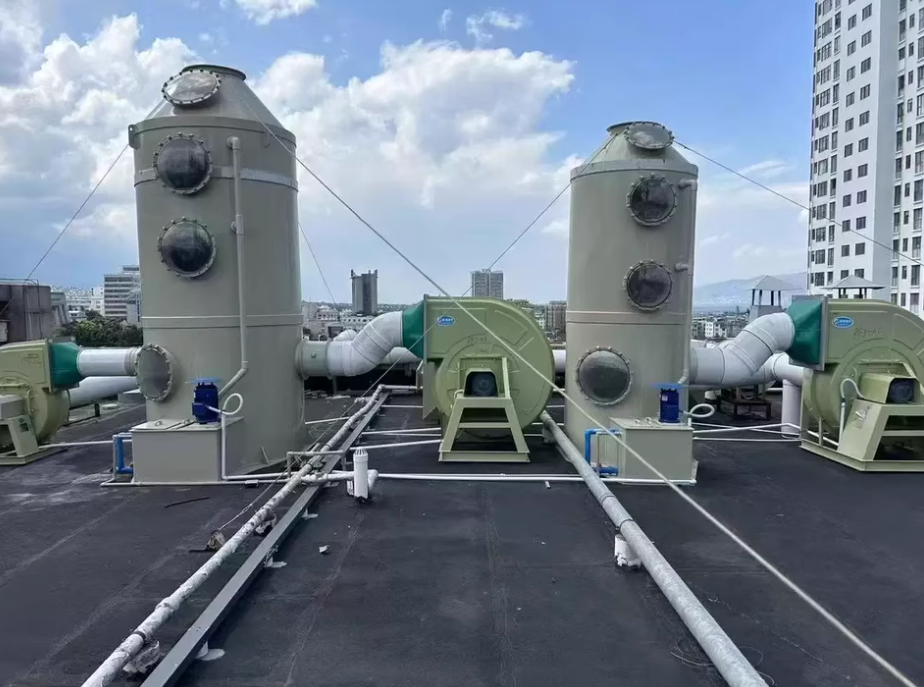
Spray towers are widely adopted in various industries including chemical production, food processing, pharmaceuticals, petroleum, machinery, laboratories, metallurgy, light industry and new energy. They are applicable for treating electroplating waste gas, pickling hydrochloric acid gas, hydrogen sulfide gas, chlorine dioxide gas and coating exhaust gas. In addition, spray towers can eliminate volatile organic compounds (VOCs), which plays an important role in air quality improvement and ecological protection.
Spray towers possess multiple advantages, including simple structure, convenient installation, easy maintenance and low manufacturing cost. The equipment ensures high purification efficiency to meet national emission standards. Furthermore, spray towers have certain fire suppression performance and can inhibit the spread of on-site fire hazards.
Nevertheless, spray towers have inherent limitations. The water circulation capacity is limited, and untimely drainage may cause water accumulation in the tank. The equipment is susceptible to corrosion when treating corrosive waste gas, so anti-corrosion measures are indispensable. Moreover, purification efficiency is affected by gas composition, concentration and temperature, requiring targeted optimization in practical application.
Multiple improvement measures can be applied to enhance purification performance and operational stability. Optimize the structure and arrangement of spray nozzles to extend gas-liquid contact time and enlarge contact area. Select high anti-corrosion materials for tower bodies and packing. Strengthen wastewater treatment to prevent secondary pollution.
In summary, spray towers are essential equipment in industrial waste gas treatment and air purification with broad application prospects and social value. With increasingly strict environmental standards and continuous technological progress, the overall performance of spray towers will be further improved to support industrial production and environmental protection.
It should be noted that spray towers are not an all-purpose solution. Enterprises shall comprehensively evaluate gas composition, concentration and emission volume to select the most suitable waste gas treatment scheme. Continuous technological research and innovation are required to explore more efficient and environmentally friendly purification methods for sustainable development.
In the future, spray towers will remain indispensable in industrial air pollution control. Through continuous structural optimization and technical upgrading, spray towers will better serve industrial production and environmental protection, creating a cleaner and healthier living environment for human beings.