
 +86 15853145085
1. Core Framework of Emission Standards for Spray Tower Equipment
As the core equipment for industrial waste gas treatment, spray towers must comply with the Integrated Emission Standard of Air Pollutants (GB 16297-1996) and local environmental protection regulations. According to the latest revised requirements, the key monitoring indicators are listed as follows:
Particulate matter emission limit: 30mg/m³ in general areas, and 20mg/m³ in key regions.
Acid gas (SO₂, HCl): 600mg/m³ under reference oxygen content (coal-fired boilers).
Organic waste gas (VOCs): Non-methane total hydrocarbons ≤ 120mg/m³, while stricter standards are implemented for special industries.
The monitoring specification requires the installation of a Continuous Emission Monitoring System (CEMS). All monitoring data shall be uploaded to the environmental protection platform with a sampling frequency of no less than once per hour.
2. Key Technical Parameters for Compliant Discharge
1. Liquid-gas Ratio Control
The theoretical optimal liquid-gas ratio ranges from 1.5 to 3.0 L/m³. Dynamic adjustment is required according to pollutant concentration in actual engineering. For example, the ratio shall be increased to 4.0 L/m³ when treating high-concentration HCl waste gas.
2. Packing Layer Optimization
Pall ring packing: Specific surface area of 250m²/m³ with pressure drop ≤ 300Pa/m.
Cascade ring packing: The treatment efficiency is increased by 15-20%, which is suitable for high-load working conditions.
3. Precise pH Regulation
Acid waste gas: Maintain pH value at 8-9 with NaOH/Ca(OH)₂ composite regulators.
Alkaline waste gas: Control pH value at 5-6 with circulating sulfuric acid or citric acid solution.
3. Typical Case Analysis of Excessive Emission
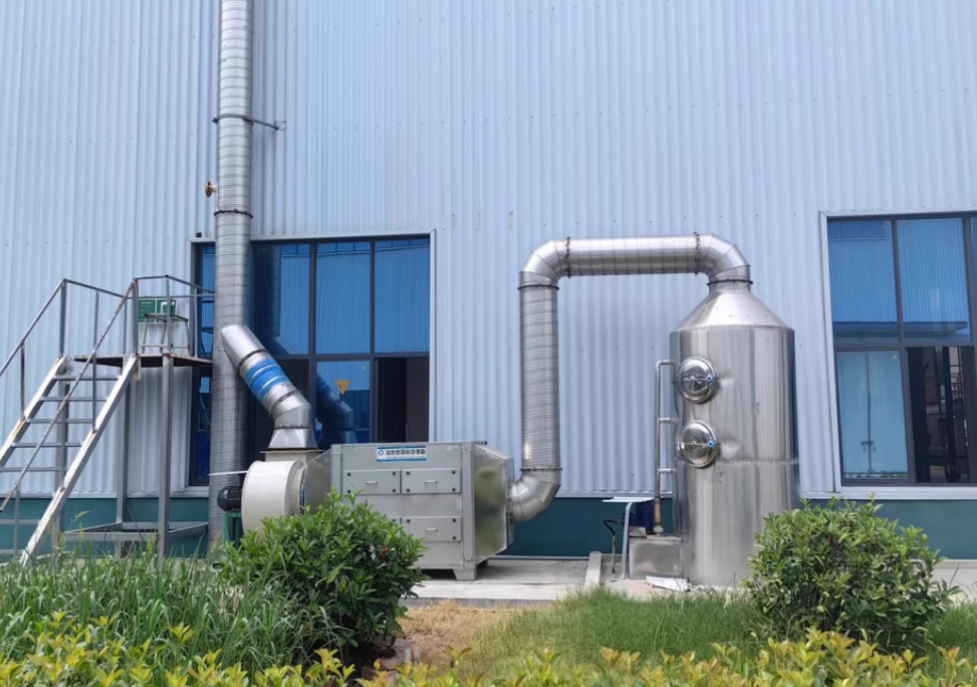
Case of excessive SO₂ concentration at the outlet of a chemical plant spray tower:
Root cause: Excessive Ca²⁺ concentration in circulating liquid leads to scaling inside the equipment.
- Solutions:
Add pre-treatment calcium removal device.
Adopt corrosion-resistant PP circulating pumps.
Implement combined pH-ORP control strategy.
Treatment effect: The SO₂ emission concentration is reduced from 850mg/m³ to 520mg/m³.
4. Technical Paths to Improve Compliance Performance
1. Intelligent Control System Upgrade
Deploy PID neural network algorithm to realize dynamic liquid-gas ratio adjustment (error < 5%) and intelligent chemical dosing prediction, reducing chemical consumption by 15-20%.
2. Composite Treatment Process Integration
Combination of spray tower and wet electrostatic precipitator increases particulate removal efficiency to 99.2%, with additional system resistance ≤ 800Pa.
3. New Material Application
Silicon carbide spiral nozzle: Atomization particle size ≤ 80μm with service life extended to 5 years.
5. Monitoring and Verification Methods
1. Performance Test Standard
Refer to HJ/T 387-2007 Technical Specification for Industrial Waste Gas Treatment Engineering. The equipment shall operate continuously for 72 hours under 70% design load during testing.
2. Data Cross Verification
The relative error between CEMS online data and manual sampling shall not exceed 10%. Third-party detection is required once a month.
6. Future Development Trends
Ultra-low emission transformation: Key industries implement new standards of 10mg/m³ for particulate matter and 35mg/m³ for SO₂.
Resource utilization: Waste liquid salt extraction technology recycles Na₂SO₄ with purity ≥ 98%.
Digital management: Establish a digital twin system for equipment to shorten fault early warning response time to 15 minutes.
Conclusion: With increasingly stringent emission standards, enterprises need to build an integrated solution including process optimization, intelligent control and resource recycling. Innovative methods such as CFD flow field simulation and nano atomization technology can reduce operating costs by 15-25% while ensuring environmental compliance. For customized technical solutions, please contact professional environmental engineering service providers.