Electrostatic precipitation applied in waste gas treatment for tire pyrolysis (core: Wet Electrostatic Precipitator, WESP, tailored for pyrolysis waste gas laden with oil mist and carbon black dust) shares the same core working mechanism as conventional electrostatic dust removal. It removes particulate matters and oil mist droplets from waste gas via four key processes: ionization, charging, collection and ash cleaning. Optimizations are made to process flow and ash cleaning modes to adapt to the oil and dust characteristics of pyrolysis flue gas. Dry electrostatic precipitators are rarely used alone here due to severe adhesion issues.
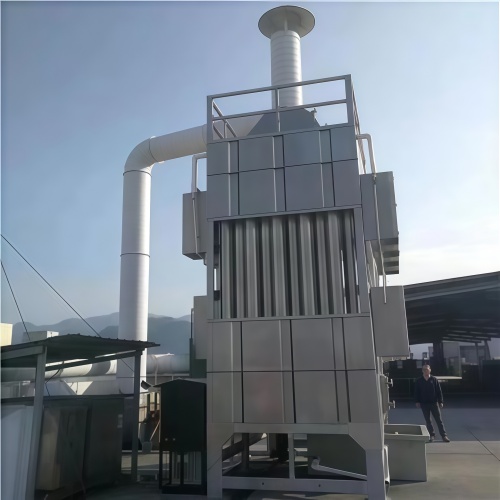
High Voltage Electrostatic Precipitator
Its overall working principle falls into four core steps. Combined with characteristics of tire pyrolysis waste gas (mainly ultra-fine carbon black dust and heavy oil mist droplets), the function and applicability of each step as well as major differences between wet-type and dry-type types are illustrated below:
Step 1: Gas Ionization to form high-voltage electrostatic collecting field
The core component is the high-voltage electrostatic field composed of discharge electrodes (negative poles connected to high-voltage DC negative power) and collecting electrodes (positive poles grounded). A high-frequency high-voltage constant current power supply (30~70kV DC) matching pyrolysis waste gas is adopted for power supply.
When high voltage is applied, a corona zone forms around discharge electrodes. Neutral gas molecules such as oxygen and nitrogen in flue gas are ionized into positive ions and free electrons, laying a foundation for subsequent particle charging. For ultra-fine carbon black dust in tire pyrolysis waste gas, thorn-type discharge electrodes are adopted to enhance ionization efficiency for sufficient gas ionization.
Step 2: Particle charging to endow dust and oil mist droplets with electric charge
Neutral particles including carbon black dust (0.01~10μm), heavy oil mist droplets and coke particles in tire pyrolysis waste gas flow through the ionized electrostatic field, collide and combine with free electrons and negative ions to rapidly carry negative charges within only several milliseconds.
This step is critical for removing ultra-fine carbon black. Electrostatic precipitation features far higher charging efficiency for submicron particles than bag dust removal, enabling full charging of hard-to-treat ultra-fine carbon black in pyrolysis waste gas and facilitating subsequent collection.
Step 3: Electric field collection for adsorption and separation of charged particles
Dust and oil mist droplets carrying negative charges overcome airflow resistance under Coulomb force in the electrostatic field, move directionally towards positively charged collecting electrodes, and finally adhere to electrode surfaces to separate from main flue gas.
In view of large air volume and high dust concentration of tire pyrolysis waste gas, electric field airflow velocity (0.8~1.2m/s) and pole spacing (400~500mm) are optimized to extend particle residence time inside the electric field, preventing dust escape caused by excessive airflow velocity and pole-to-pole short circuit resulted from oil mist adhesion.
Step 4: Ash cleaning and desorption for electrode cleaning and particle collection
This is the core difference between electrostatic dust removal for tire pyrolysis waste gas and conventional types, as well as the key to working condition adaptability. Conventional dry electrostatic precipitators adopt rapping ash cleaning, which will cause secondary flying of oil dust and electrode adhesion when applied to oil mist-containing pyrolysis flue gas. Therefore, WESP adopts continuous spray ash cleaning.
A low-pressure spray system is arranged on collecting electrodes. Continuous water films are formed on electrode surfaces by spraying water or weak alkaline solution. Oil dust attached on electrodes is washed away by water films and flows into the liquid collecting tank at the equipment bottom along with spray liquid to complete ash cleaning. Meanwhile, spray liquid can synergistically absorb trace acidic pollutants such as hydrogen sulfide and phenols in waste gas to improve purification performance.
Supplementary Advantages of WESP for Tire Pyrolysis Waste Gas
Extremely high charging and collection efficiency (95%~99%) for 0.01~10μm ultra-fine carbon black dust, solving the core difficulty in particulate matter treatment of tire pyrolysis waste gas.
Continuous spray ash cleaning fundamentally eliminates electrode adhesion caused by oil mist and carbon black, ensuring long-term stable equipment operation.
Low system operating resistance of only 50~200Pa without high-energy-consumption induced draft fans, meeting the cost control demand of continuous operation in the tire pyrolysis industry.
Brief Summary
Essentially, electrostatic dust removal for tire pyrolysis waste gas charges oil and dust particles via high-voltage static electricity, captures particles by electric field force, and replaces rapping cleaning with water film spraying for ash removal. It complies with universal physical principles of electrostatic precipitation, and perfectly adapts to special working conditions of oil-containing and ultra-fine carbon black-laden pyrolysis waste gas through optimized ash cleaning design.

 +86 15853145085