
 +86 15853145085
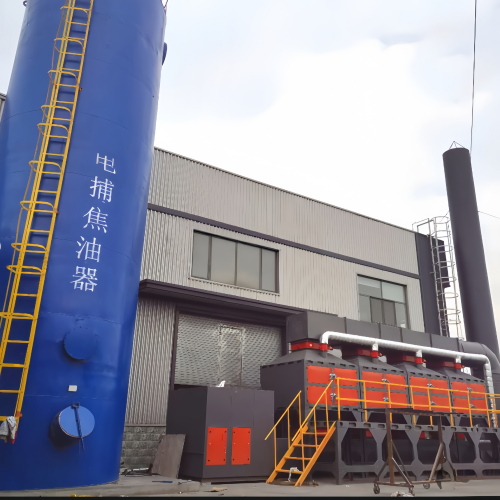
Tar waste gas features complex components, high viscosity, flammability, explosiveness and condensability. The treatment process adopts a combined technology of pretreatment + main treatment + terminal treatment. The core principle is to remove tar droplets and reduce viscosity firstly, and then carry out advanced purification. The mainstream tar waste gas treatment schemes and applicable scenarios are listed as follows:
Ⅰ. Pretreatment Process (Tar Droplet Removal & Load Reduction)
The purpose of pretreatment is to separate large-diameter tar liquid droplets in waste gas, prevent subsequent equipment blockage and avoid efficiency reduction of the main treatment process.
1. Mechanical Separation Method
Principle: Gravity, inertia force and centrifugal force are applied to separate tar droplets from gas.
Common Equipment: Gravity settling chamber, inertial separator, cyclone separator.
Characteristics: Simple structure, low investment and convenient maintenance. However, the removal efficiency for tar droplets smaller than 5μm is low (only 30%~60%), which is suitable for primary pretreatment.
Applicable Scenarios: Working conditions with high tar content and large particle size, such as waste gas pretreatment in coking plants and coal gasification workshops.
2. Wet Scrubbing Method
Principle: Scrubbing liquid (water or special absorbent) is in full contact with waste gas. Tar droplets are captured by liquid drops and discharged together with scrubbing liquid.
Common Equipment: Spray tower, packed tower, venturi scrubber.
Characteristics: High removal efficiency for fine tar droplets (60%~90%). It can also reduce temperature and remove partial soluble pollutants. However, tar-containing wastewater will be generated, requiring supporting wastewater treatment system. In addition, the scrubbing liquid is easily contaminated and needs regular replacement.
Applicable Scenarios: High-temperature, high-humidity and high-tar-concentration waste gas, such as waste gas from asphalt mixing and carbon black production.
3. Electric Tar Removal Method
Principle: Waste gas passes through a high-voltage electric field. Charged tar droplets are adsorbed by electrodes to realize gas-liquid separation.
Common Equipment: Electric tar precipitator (concentric circle type, tubular type, honeycomb type).
Characteristics: Extremely high removal efficiency (90%~99%), especially effective for tar droplets with particle size of 1~5μm. The equipment features low resistance and stable operation, while the investment and maintenance cost are relatively high. Explosion-proof and anti-corrosion design are required, and tar adhered on electrodes needs regular cleaning.
Applicable Scenarios: High-precision pretreatment in industries such as coal gas purification, coking and coal chemical industry. It is the preferred core process for tar waste gas pretreatment.
Ⅱ. Main Treatment Process (Organic Pollutant Degradation & Removal)
The pretreated waste gas requires further degradation of tar organic matters (such as polycyclic aromatic hydrocarbons) to meet emission standards.
1. Catalytic Oxidation (CO)
Principle: Waste gas is heated to 200~400℃. Under the action of catalyst, tar organic matters are oxidized and decomposed into CO₂ and H₂O.
Characteristics: Low ignition temperature, low energy consumption and high treatment efficiency (95%~99%) without secondary pollution. Nevertheless, catalysts are vulnerable to poisoning caused by tar, sulfur and phosphorus. Strict pretreatment is essential to prevent catalyst blockage and deactivation.
Applicable Scenarios: Tar waste gas with medium and low concentration (1000~5000mg/m³) and stable air volume, such as mixed organic waste gas containing a small amount of tar in coating and printing industries.
2. Regenerative Thermal Oxidation (RTO/RCO)
Principle:
RTO: Waste gas is heated to 750~850℃ for direct combustion and decomposition. Heat regenerators recover waste heat to reduce energy consumption.
RCO: Combining heat regeneration and catalytic combustion, the reaction temperature is reduced to 300~400℃ with lower energy consumption.
Characteristics: High treatment efficiency (over 99%), suitable for working conditions with high concentration and large air volume. RTO can tolerate a small amount of residual tar, but heat accumulators need regular cleaning. Similarly, RCO requires strict pretreatment to avoid catalyst poisoning.
Applicable Scenarios: High-concentration (>5000mg/m³) tar waste gas with complex components, such as waste gas from coal chemical industry and asphalt processing.
3. Adsorption Method
Principle: Adsorbents such as activated carbon and molecular sieve are adopted to adsorb tar organic matters in waste gas.
Characteristics: Simple equipment and convenient operation, suitable for low-concentration waste gas. Adsorbents are easy to saturate and require regular regeneration or replacement. The high viscosity of tar will block adsorption pores, so pretreatment is indispensable.
Applicable Scenarios: Terminal treatment of low-concentration (<1000mg/m³) and small-air-volume tar waste gas, or used as an advanced purification process.
4. Biodegradation Method
Principle: Microbial metabolism is utilized to decompose tar organic matters into harmless substances.
Characteristics: Low operating cost and no secondary pollution. However, the treatment efficiency is greatly affected by temperature and humidity, and it has poor tolerance to high-concentration toxic tar organics.
Applicable Scenarios: Low-concentration and biodegradable tar waste gas, such as slightly polluted waste gas from food processing and small rubber factories.
Ⅲ. Recommended Combined Processes
Due to the high viscosity and complex composition of tar waste gas, a single process cannot meet emission standards. The mainstream combined schemes are as follows:
High-concentration tar waste gas: Electric tar precipitator → RTO/RCO → Discharge
Medium-concentration tar waste gas: Spray tower + Electric tar precipitator → Catalytic oxidation → Discharge
Low-concentration tar waste gas: Cyclone separator → Activated carbon adsorption → Desorption and regeneration → Catalytic oxidation
Ⅳ. Key Precautions
Explosion Protection & Safety: Tar waste gas is flammable and explosive. All equipment shall be designed with anti-static and explosion-proof structures, and explosion relief devices shall be equipped.
Blockage Prevention: Tar dirt shall be cleaned regularly during pretreatment to avoid pipeline and equipment blockage. Anti-viscosity materials (such as PTFE) are recommended.
Secondary Pollution Control: Tar-containing wastewater generated by wet scrubbing shall be treated separately. The replacement and regeneration of adsorbents and catalysts shall comply with environmental regulations.