
 +86 15853145085
The combined process of spray tower + electric tar precipitator + catalytic oxidation + discharge is a typical treatment procedure for organic waste gas (VOCs) and oil mist / tar-containing waste gas. The core technical logic is to remove impurities and viscous pollutants firstly, then efficiently purify organic contaminants, and finally realize compliant discharge.
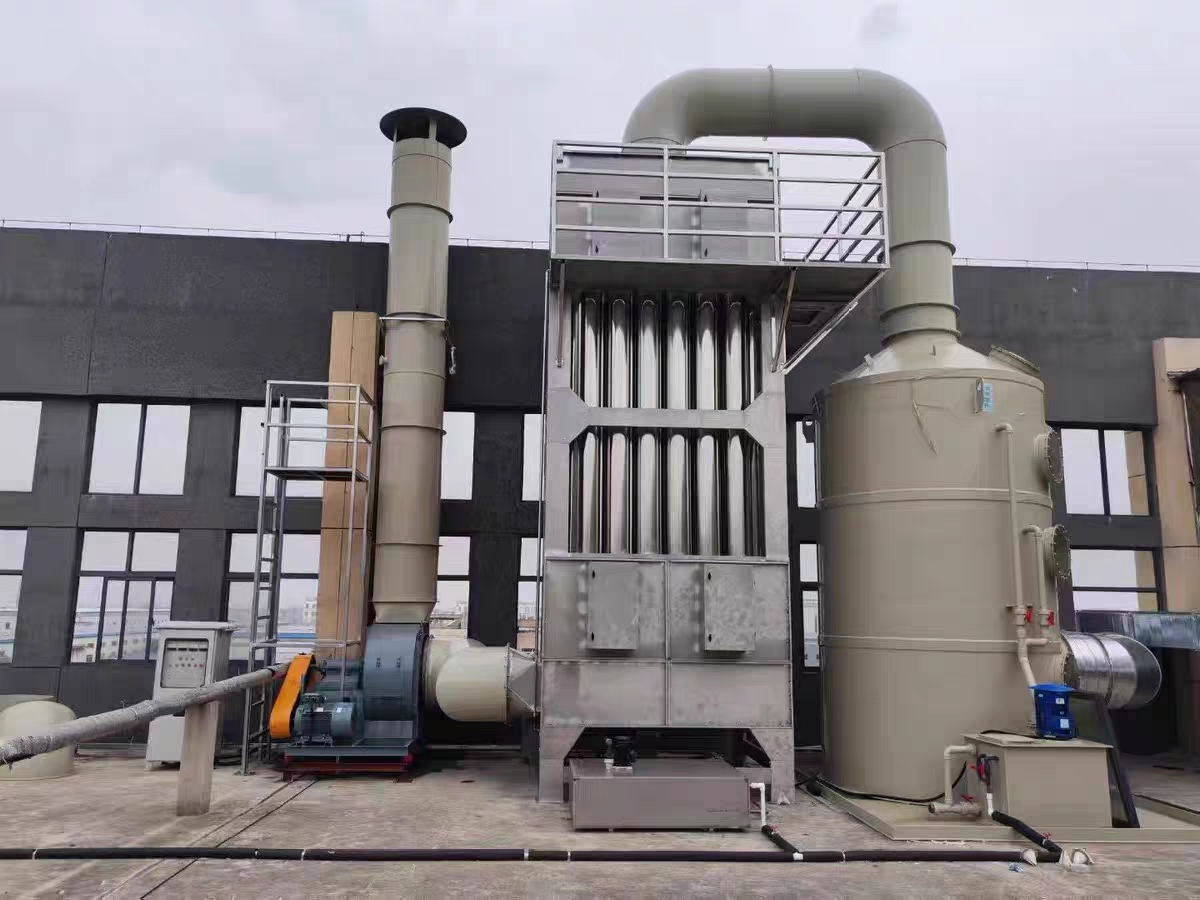
Ⅰ. Pretreatment Section: Spray Tower + Electric Tar Precipitator
The core objective of this section is to remove particulate matter, oil mist, tar and water-soluble impurities in waste gas. It protects the subsequent catalytic oxidation system and prevents catalyst poisoning and blockage.
1. Spray Tower
Function: Adopting the gas-liquid countercurrent contact principle to remove water-soluble dust, partial viscous oil mist, acidic and alkaline pollutants.
Common Spray Liquid: Clean water (for dust and oil mist removal), lye (for acidic waste gas such as sulfide), acid liquid (for alkaline waste gas).
Advantages: Low operating cost and simple operation. It achieves preliminary cooling and stabilizes the gas temperature before entering the catalytic oxidation unit.
Limitations: Low removal efficiency for macromolecular tar and viscous oil mist. It must be matched with an electric tar precipitator for advanced purification.
2. Electric Tar Precipitator
Function: Efficiently capture tar droplets and fine oil particles that cannot be removed by the spray tower, with a removal efficiency of over 90%.
Working Principle: Under a high-voltage electrostatic field, oil mist particles are charged and adsorbed on electrode plates. Aggregated pollutants flow down by gravity to realize gas-liquid separation.
Key Significance: Tar and oil mist are fatal to catalysts. They will cover the active sites and cause irreversible catalyst deactivation. The electric tar precipitator fundamentally solves this problem.
Ⅱ. Core Purification Section: Catalytic Oxidation (CO)
The pretreated waste gas enters the catalytic oxidation system for organic pollutant decomposition and purification.
Working Principle: With the action of catalysts (precious metals such as platinum and palladium, or non-precious metals such as manganese and cobalt oxides), organic waste gas is oxidized and decomposed into carbon dioxide and water at a low temperature of 200–400℃ without secondary pollution.
Process Advantages
1. Low light-off temperature, saving more than 80% energy compared with direct combustion (600–800℃);
2. High purification efficiency, with VOCs removal rate ranging from 95% to 99%;
3. Fast reaction speed, small equipment size and compact floor area.
Operation Precautions
1. The waste gas concentration shall be controlled below 25% of the lower explosion limit to eliminate potential safety hazards;
2. Thorough pretreatment is required to prevent dust and tar from entering the catalytic bed;
3. Regular inspection of catalyst activity is necessary. Deactivated catalysts shall be regenerated or replaced in a timely manner.
Ⅲ. Applicable Scenarios
This combined process is specially designed for waste gas containing heavy oil mist, tar and medium-low concentration VOCs. Typical industries are listed as follows:
1. Tar-containing waste gas from coal chemical industry, asphalt mixing plants and coking plants;
2. Oil mist and organic mixed waste gas from metal processing, coating and printing industries;
3. Viscous waste gas from rubber, plastic and pharmaceutical industries.
Ⅳ. Key Process Control Points
Pretreatment Sequence: The spray tower must be arranged in the front, followed by the electric tar precipitator. The spray tower removes large-particle dust to avoid electrode blockage of the electric tar precipitator.
Gas Parameter Adjustment: Before entering the catalytic oxidation device, the waste gas shall be preheated to the catalyst light-off temperature, and the humidity shall be strictly controlled to prevent catalyst moisture failure.
Safety Measures: The system shall be equipped with flame arresters, explosion-proof valves and concentration monitors to prevent explosion risks caused by excessive gas concentration