
 +86 15853145085
Among steel-structured chemical plants and complicated pipeline systems in pharmaceutical workshops, plain tower-shaped equipment operates around the clock. The stainless steel spray tower is an essential gas-liquid contact device and a core component of industrial waste gas treatment systems. Similar to a professional bartender, it mixes waste gas and liquid to realize the conversion of harmful pollutants through simple mixing processes.
Evolution and Purification Principle of Stainless Steel Spray Towers
The technical origin of spray towers can be traced back to the late 19th century during the initial development of the chemical industry. Early equipment was simple packing towers. Workers accidentally found that pungent odor could be reduced when waste gas passed through moist coke layers, which promoted the development of systematic gas-liquid mass transfer theory. Modern spray towers are designed based on the double-film theory. Pollutant molecules diffuse from the gas phase to the gas-liquid interface and finally enter the liquid phase. This process is governed by physical and chemical laws such as Henry's Law and Fick's Diffusion Law. Compared with biofilters and activated carbon adsorption devices, spray towers perform better in treating high-concentration and high-volume waste gas. Data from a petrochemical enterprise shows that a single spray tower can process 100,000 cubic meters of waste gas per hour.
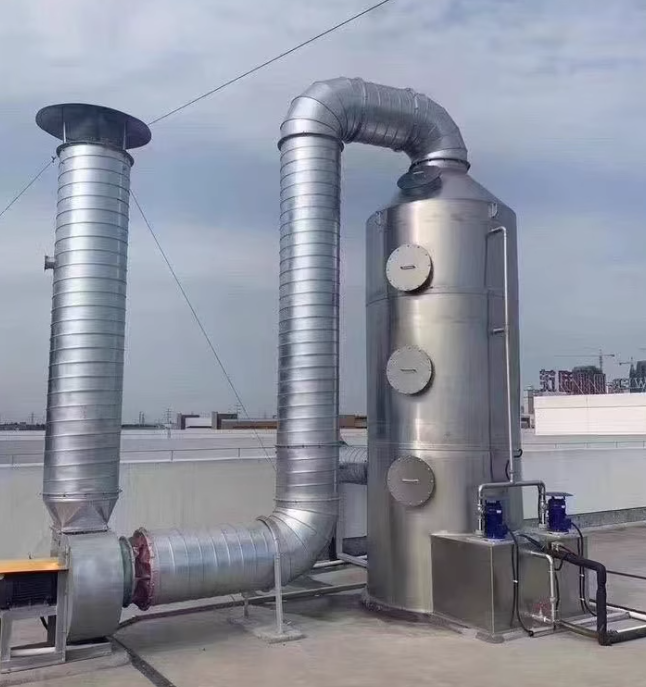
Fluid Engineering Design of Stainless Steel Structure
A standard spray tower is a typical example of industrial engineering design. The tower body is generally made of polypropylene (PP) or stainless steel with multiple precision internal components. Spiral nozzles at the top atomize liquid into fine droplets of 50 to 200 microns to create a large gas-liquid contact area. Structured ceramic rings and plastic saddle packing are adopted in the packing layer, with a specific surface area ranging from 200 to 700㎡/m³. Mist eliminators intercept escaped liquid droplets like fine screens. An environmental protection enterprise in Shanghai developed a cyclone-spray composite tower. By introducing cyclone separation principles, the particle removal efficiency reaches 99%. Structural innovations maximize mass transfer efficiency within limited space.
Intelligent Evolution of Chemical Absorption Technology
Modern spray towers have evolved from simple physical trapping into intelligent chemical reactors. Customized absorbents are applied for different pollutants. Sodium hydroxide solution is used for acidic gas treatment with a neutralization efficiency of over 95%. Dilute sulfuric acid is adopted to treat ammonia gas and generate recyclable ammonium sulfate. Special surfactant solution is used to improve the solubility of VOCs. Nano-catalysts are added into absorbents in advanced technologies. A TiO₂ photocatalytic spraying system developed by a research institute improves formaldehyde degradation efficiency by 40% under ultraviolet irradiation. These upgrades transform spray towers from passive absorption into active pollutant conversion and reduce subsequent processing load.
Diversified Cross-industry Application
Spray towers are widely applied in various industries. In the semiconductor industry, they treat acidic waste gas generated during etching processes. In waste incineration plants, they act as the primary barrier against dioxins. Seawater spray towers are cost-effective solutions for ship desulfurization that meet IMO 2020 standards. Miniaturized electrostatic-spray composite equipment developed by an environmental protection company in Beijing is applied in catering oil fume treatment. It achieves an oil fume removal rate of 98% with only one-third of the traditional floor area, reflecting strong adaptability of spray tower technology.
Efficiency Improvement in the Digital Era
Intelligent upgrading brings new vitality to traditional spray towers. IoT sensors monitor key parameters including pH value, liquid level and pressure drop in real time. Cloud platforms predict packing blockage trends through big data analysis. Automatic dosing systems adjust chemical dosage dynamically according to waste gas concentration. An intelligent spraying system installed in an electroplating park in Guangdong optimizes spraying frequency through machine learning algorithms, reducing chemical consumption by 25% while maintaining stable purification performance. Digital operation modes eliminate the drawbacks of extensive traditional operation.
The evolution of stainless steel spray towers from simple wet dust removal to complex gas purification reflects the upgrading of industrial environmental protection concepts. With the application of new materials and advanced processes, spray towers will continue to play a vital role in waste gas treatment. The most effective environmental protection technologies are not the most complicated ones, but those that maximize basic physical principles. With simple structure and reliable performance, spray towers prove that excellent technical design is based on in-depth understanding of natural laws.