
 +86 15853145085
I. System Faults of Spray Tower Waste Gas Treatment Equipment
Problem 1: Nozzle Blockage
Typical symptoms: Reduced spraying coverage and increased fluid resistance displayed on the differential pressure gauge.
Causes:
Solid impurity deposition in circulating liquid (common when CaCO₃ content is higher than 200mg/L);
Polymer precipitation caused by sudden pH fluctuation and flocculation;
Unreasonable nozzle structure, straight-flow nozzles are prone to blockage.
Solutions:
Disassemble and inspect 20% of nozzles every month, giving priority to the bottom layer;
Install an automatic backwash filter with a precision of 100μm;
Replace with anti-blocking spiral nozzles.
Problem 2: Uneven Spraying
Typical symptoms: Dry areas appear on the tower wall, and gas treatment efficiency decreases by more than 15%.
Causes:
Hydraulic imbalance of water distribution pipeline with terminal pressure drop over 10%;
Mixed use of different nozzle types with flow coefficient difference exceeding 5%;
Deformed support frame with horizontal deviation over 3°.
Solutions:
Adopt annular main pipe and radial branch pipe water distribution system;
Uniformly replace with hollow cone nozzles with a spray angle of 90°±2°;
Install laser level calibration devices.
II. Packing Layer Faults of Spray Tower
Problem 3: Packing Collapse
Typical symptoms: Bed pressure drop suddenly decreases by 30% and gas short circuit occurs.
Causes:
Softening of plastic packing under long-term high temperature above 80℃;
Thinning of ceramic packing caused by acid corrosion with wall thickness less than 50% of the original;
Excessive span of support grating (more than 1.5 times the packing diameter).
Solutions:
Use reinforced PP packing with flexural modulus higher than 1500MPa;
Densify support grating with spacing less than 0.8 times the packing diameter;
Add intermediate redistributors every 3 meters of bed height.
Problem 4: Packing Scaling
Typical symptoms: Continuous pressure rise over 50Pa per week.
Causes:
Precipitation of calcium and magnesium ions when water hardness exceeds 300mg/L;
Excessive biofilm growth when COD value is higher than 500mg/L;
Dust adhesion when inlet dust concentration exceeds 50mg/m³.
Solutions:
Implement monthly chemical cleaning with 5% citric acid circulating for 2 hours;
Add a pre-washing section to remove large particles;
Adopt ultraviolet sterilization of 30W per cubic meter of tower volume.
III. Gas-Liquid Mass Transfer Problems
Problem 5: Water Carryover of Mist Eliminator
Typical symptoms: Liquid droplets appear in the outlet pipeline and cause corrosion to fan impellers.
Causes:
Excessive blade spacing of mist eliminator (over 30mm);
Excessive gas velocity exceeding 120% of the designed value;
Abnormal surface tension caused by surfactant contained in waste gas.
Solutions:
Replace with wave-plate mist eliminator with 20mm spacing;
Install gas velocity monitoring interlock device;
Add defoamer with concentration of 0.5-1ppm.
Problem 6: Decreased Absorption Efficiency
Typical symptoms: Outlet pollutant concentration exceeds 150% of the designed standard.
Causes:
Unbalanced liquid-gas ratio (L/G<2L/m³);
Insufficient mass transfer driving force with pH deviation exceeding ±1.5 from the optimal value;
Insufficient gas-liquid contact time (less than 1.5s).
Solutions:
Optimize circulating pump frequency to maintain spraying density of 12-15m³/(m²·h);
Equip automatic dosing system with pH control accuracy of ±0.2;
Increase packing height to extend contact time by 0.5 seconds per meter.
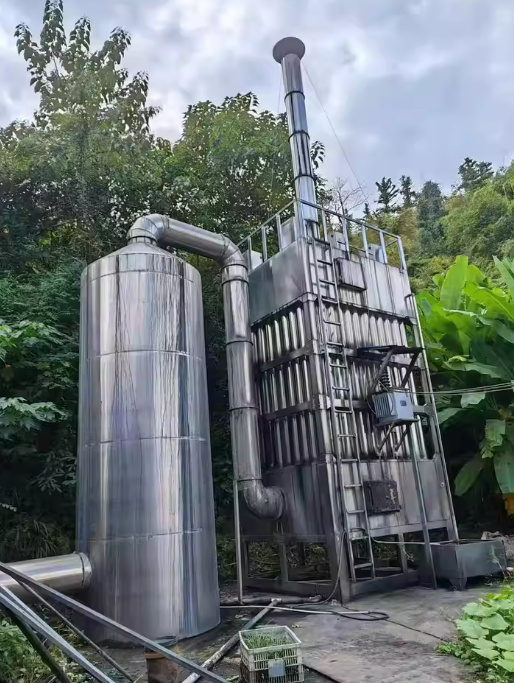
IV. Structural Faults of Spray Tower
Problem 7: Shell Corrosion
Typical symptoms: Pitting corrosion on wall plates with depth over 1mm per year.
Causes:
Interlayer bonding failure of FRP with resin content lower than 35%;
Incomplete penetration of PP welding (defect over 10% of plate thickness);
Local ultra-high temperature exceeding material temperature resistance limit.
Solutions:
Adopt 3mm thick 316L stainless steel lining;
Conduct 100% penetration testing (PT testing) after welding;
Add thermal insulation layer with thermal conductivity below 0.05W/(m·K).
Problem 8: Flange Leakage
Typical symptoms: Continuous liquid leakage at bolts (more than 5 drops per minute).
Causes:
Insufficient gasket compression (less than 25% of thickness);
Flange parallelism deviation over 0.2mm/m;
Bolt stress relaxation with preload loss exceeding 30%.
Solutions:
Replace with expanded PTFE gasket with compression rate of 30-35%;
Calibrate flanges with laser aligner;
Tighten bolts secondly by hydraulic wrench according to torque curve.
V. Systematic Optimization Suggestions
Preventive Maintenance System
Establish a baseline database for key parameters such as differential pressure, pH value and flow rate;
Implement standardized maintenance: regular disassembly inspection, fixed-point monitoring and personal responsibility;
Scan abnormal temperature areas with infrared thermal imager every month.
Intelligent Upgrading Scheme
Install online corrosion monitoring probes with precision of 0.01mm;
Equip AI early warning system to predict faults 4 to 8 hours in advance;
Optimize operating parameters through digital twin simulation.
Through systematic diagnosis and accurate treatment, the operational stability of spray towers can be improved by more than 60%, and the maintenance cost can be reduced by 35%. It is recommended to compile quarterly failure mode analysis reports to continuously optimize the equipment management system. For frequently repeated faults, equipment renovation and process optimization of spray towers should be considered.