
 +86 15853145085
Abstract: As a common gas purification device, stainless steel spray towers are widely used in waste gas treatment and air purification. This article introduces the working principle, structural composition, application fields and selection guidelines of spray towers to help readers understand and apply the equipment better.
1. Introduction of Stainless Steel Spray Tower
A spray tower, also known as a scrubber, removes gas pollutants through gas-liquid mass transfer by contacting gas with liquid absorbents. Featuring simple structure, convenient operation and high purification efficiency, it is widely used for waste gas treatment and air purification.
2. Working Principle of Stainless Steel Spray Tower
The spray tower operates based on gas-liquid mass transfer theory. Polluted gas enters from the tower bottom and makes countercurrent contact with liquid absorbent sprayed from the top. With the help of packing layers or spraying devices, gas and liquid mix sufficiently. Pollutants transfer from gas phase to liquid phase to complete gas purification.
3. Structural Composition of Stainless Steel Spray Tower
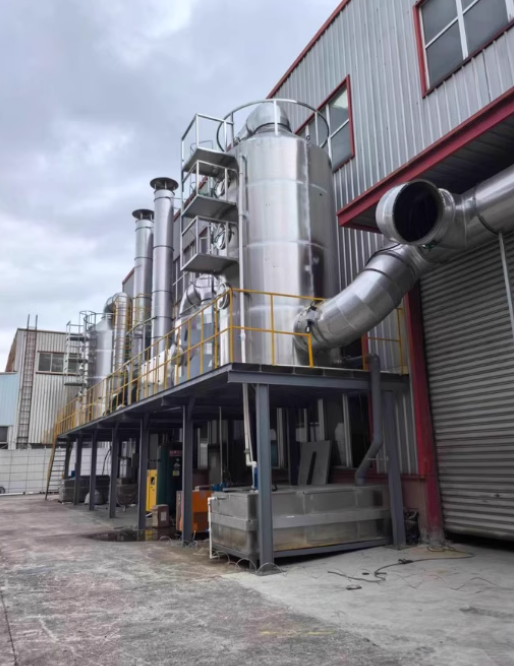
A spray tower mainly consists of tower body, packing layer, spraying device and mist eliminator.
Tower body: It is generally designed in cylindrical shape. Materials such as carbon steel, stainless steel and fiberglass can be selected according to medium characteristics.
Packing layer: As the core component, it increases gas-liquid contact area and improves mass transfer efficiency. Common packing includes Raschig rings, Pall rings and cascade rings.
Spraying device: It distributes liquid absorbent evenly over the packing layer. Nozzles and spraying pipes are commonly adopted.
Mist eliminator: It removes entrained liquid droplets to prevent the loss of absorbent liquid.
4. Application Fields of Stainless Steel Spray Tower
Waste gas treatment: Remove dust, sulfur dioxide, nitrogen oxides, hydrogen chloride, hydrogen fluoride and other pollutants.
Air purification: Eliminate peculiar smell, bacteria and viruses in the air.
Other fields: Apply to gas cooling, humidification and dust removal.
5. Selection Guidelines of Spray Tower
Air volume: Determine appropriate tower diameter and height according to actual processing air volume.
Pollutant type and concentration: Select suitable absorbents and packing based on pollutant properties.
Treatment efficiency: Choose equipment model and operating parameters in accordance with emission standards.
Operating cost: Consider equipment investment, operating expense and maintenance cost.
6. Advantages and Disadvantages
Advantages:
Simple structure and easy operation;
High treatment efficiency and wide application range;
Relatively low investment cost.
Disadvantages:
High operating consumption of water and absorbents;
Potential secondary pollution requiring proper wastewater treatment;
Low removal efficiency for insoluble gas pollutants.
7. Conclusion
As an efficient and practical gas purification device, stainless steel spray towers play an important role in environmental protection. With continuous technological progress, spray towers will achieve better performance and broader application prospects.