 +86 15853145085
Veterinary preparations are medications used to regulate the physiological functions of livestock and poultry and to prevent or treat diseases. They encompass plant, animal, and mineral sources, as well as artificially synthesized chemical drugs and immunological agents. However, the production process generates waste gas pollutants such as dust particles, acidic/alkaline gases, and Volatile Organic Compounds (VOCs). If these pollutants are discharged directly into the atmosphere without collection and purification, they will not only cause environmental pollution but also endanger the health of workshop employees. Therefore, it is essential to purify veterinary preparation exhaust gas to meet atmospheric pollutant emission standards.
The production of veterinary preparations covers multiple stages, including active pharmaceutical ingredient (API) synthesis, formulation processing, and packaging. The exhaust gas mainly originates from the following three aspects:
(1) Chemical Reaction Process: Steps such as heating, reaction, and distillation in raw material synthesis produce organic solvent waste gas (e.g., ethanol, acetone), acidic gases (e.g., hydrogen chloride), and malodorous substances.
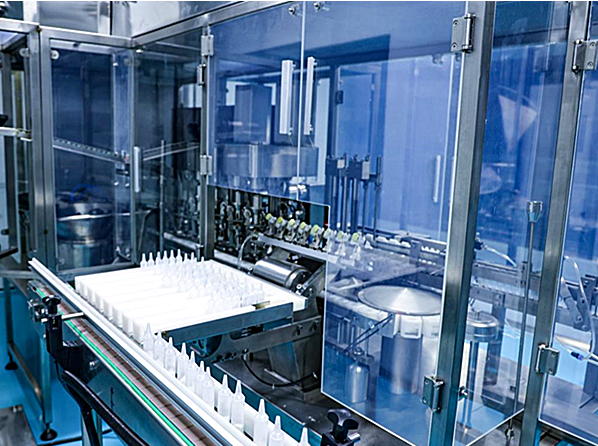
(2) Formulation Processing: Operations like crushing, mixing, and granulation easily generate dust, while drying and sterilization steps may release VOCs.
(3) Auxiliary Systems: Tank breathing and laboratory analysis also emit small amounts of pollutants.
These exhaust gases have complex compositions, primarily containing dust, Volatile Organic Compounds (VOCs), and acidic gases. Improper treatment will not only pollute the surrounding environment but also affect the health of enterprise employees.
3. Treatment Methods for Veterinary Preparation Exhaust Gas
The pollutants generated during the production of veterinary preparations are mainly dust particles, acidic gases, and Volatile Organic Compounds (VOCs). Dust particles are treated using Baghouse or Cartridge Dust Collection methods, while acidic gases are treated using Alkaline Spray Scrubbing. There are various methods for treating VOC waste gas, with common ones including Activated Carbon Adsorption, Regenerative Thermal Oxidation (RTO), Activated Carbon Adsorption-Desorption + Catalytic Oxidation (CO), Zeolite Rotor Concentration + RTO, and Zeolite Rotor Concentration + CO. The following section provides a detailed introduction to these treatment methods.
3.1 Dust Particle Treatment Methods
(1) Baghouse Dust Collection Method
The exhaust gas containing dust collected by hoods is transported through ducts into the pre-dust collection chamber of the baghouse equipment. Upon encountering set obstacles, the direction of the dusty airflow changes sharply. Coarse dust particles hit the obstacles, altering their original trajectory, with a portion falling into the ash hopper. The remainder enters the filtration chamber equipped with filter bags along with the airflow. Dust adheres to the outer surface of the filter bags, while the clean air passes through the bags, goes through the upper clean air chamber and exhaust duct, and is finally discharged by the fan through a 15-meter exhaust stack.
The principle of baghouse dust collection involves passing dusty exhaust gas through filter media, where dust particles are filtered out. The capture of coarse dust relies mainly on inertial collision, while fine dust is captured primarily through diffusion and sieving. The dust layer on the filter media also contributes to filtration. The dust removal efficiency of a baghouse collector can reach over 99%.
(2) Cartridge Dust Collection Method
As the fumes collected by hoods enter the cartridge dust collector through the upper inlet, larger particles (diameter around 100μm) settle first. Smaller particles (diameter 0.1–50μm) are adsorbed onto the surface of the cartridges within the air treatment chamber. The purified air passing through the cartridges is then discharged from the exhaust chamber. When the equipment's operating resistance reaches a certain level, the pulse controller triggers the solenoid valve to open. Compressed air (P=0.5–0.6 Mpa) is blown into the interior of the cartridges via a blowpipe, causing the dust particles to detach instantly under high-pressure airflow. This reduces filtration resistance and completes the cleaning process. Periodic cleaning of dust on the cartridge surfaces keeps the equipment's operating resistance relatively stable, which is a crucial step in ensuring the normal operation of the dust collection system. Settled and cleaned dust accumulates in the ash hopper, where it is automatically discharged by an discharge valve or collected in an ash barrel for regular manual disposal.
Cartridge dust collectors can achieve an efficiency of up to 98%. They are suitable for industries requiring large filtration areas and handling high volumes of dust. The compact cartridge elements are easy to install, operate, and maintain.
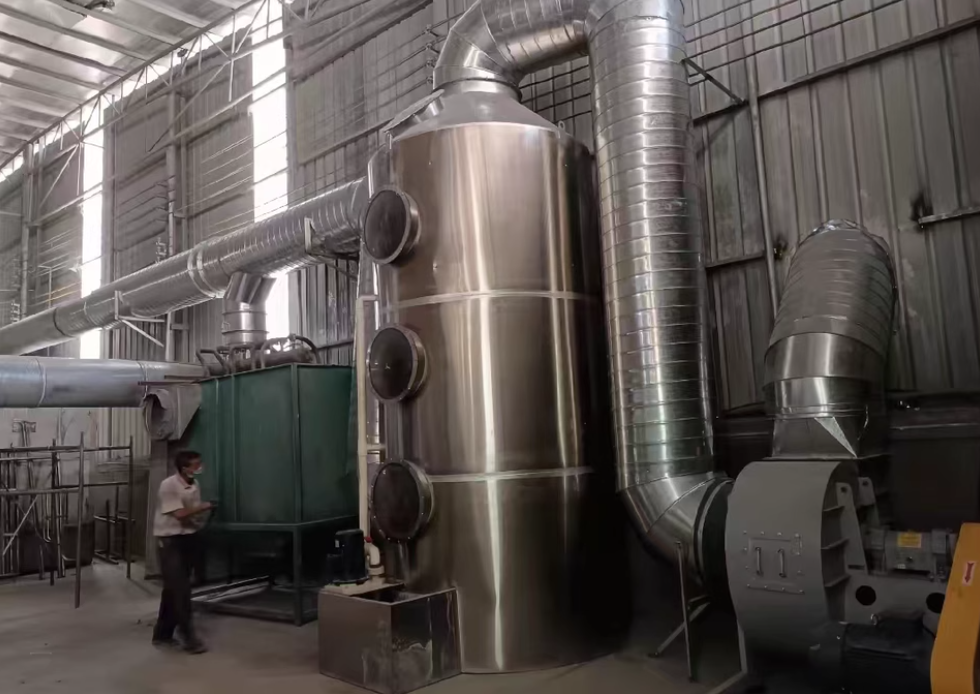
Acidic waste gas is treated using an "Alkaline Spray Scrubber," with a 10% sodium hydroxide (NaOH) solution serving as the absorption liquid. Alkaline scrubbing is widely used for treating acidic gases due to its stable operation, excellent treatment results, low investment, and low processing costs.
3.3 VOCs Waste Gas Treatment Methods
(1) Activated Carbon Adsorption Method
This method uses porous solid adsorbents (such as activated carbon, silica gel, molecular sieves, etc.) to treat organic waste gas. Harmful components are thoroughly adsorbed onto the surface of the adsorbent through chemical bonding or molecular attraction, thereby achieving purification. Currently, the adsorption method is mainly applied to the purification of low-concentration (≤800mg/m³), large-volume,ambient temperature organic waste gas that contains no particulates or sticky substances.
Activated carbon offers high purification rates (over 90%), wide applicability, simple operation, and low initial investment. However, once the activated carbon becomes saturated, it needs to be replaced, which incurs costs. Furthermore, the spent saturated activated carbon must be handled by professionals as hazardous waste, resulting in high operating costs.
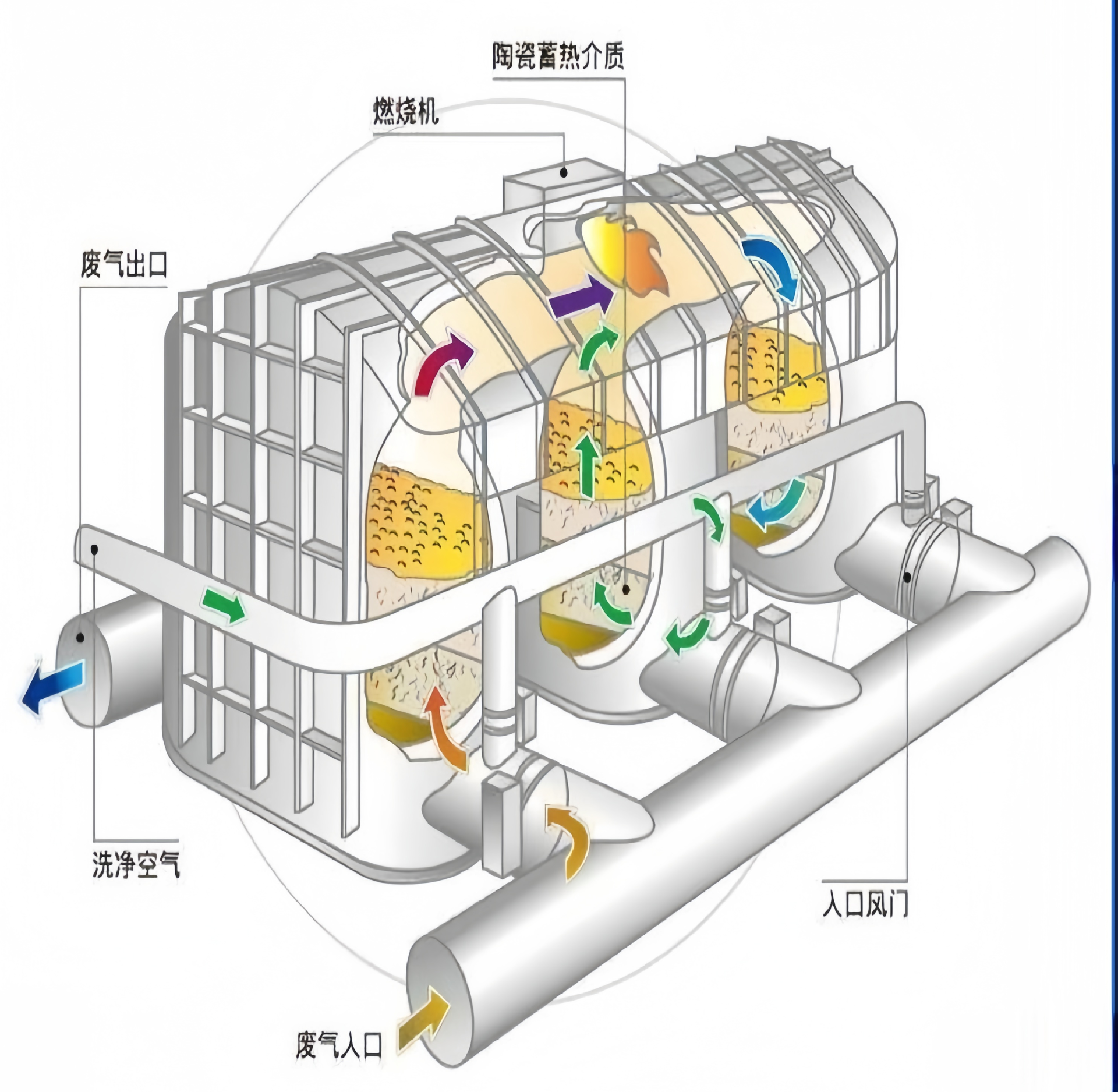
(2) RTO (Regenerative Thermal Oxidation) Method
The RTO method heats organic waste gas to above 760°C, oxidizing and decomposing the Volatile Organic Compounds (VOCs) in the combustion chamber into carbon dioxide and water. The high-temperature gas generated from combustion flows through specially designed ceramic heat storage media, raising their temperature to "store heat." This stored heat is then used to preheat the incoming organic waste gas, saving fuel consumption required for heating and reducing operating costs.
RTO boasts high purification efficiency, reaching 95-99%. Compared with traditional Catalytic Oxidation (CO) or Thermal Oxidation (TO) methods, RTO features high thermal recovery efficiency (≥95%) and low operating costs, making it capable of treating large volumes of low-concentration waste gas. When the concentration is slightly higher, secondary waste heat recovery can be implemented, significantly lowering production operating costs.
(3) Activated Carbon Adsorption Concentration + CO Catalytic Combustion Method
This method utilizes activated carbon to adsorb VOCs from large volumes of low-concentration waste gas. Once the activated carbon is saturated, a small volume of high-temperature gas is used to desorb (regenerate) the carbon. The resulting high-concentration gas is then sent to a CO catalytic combustion furnace for burning. The hot steam produced from combustion is used for the desorption of the activated carbon, allowing the carbon to recover and be recycled.
The Activated Carbon Adsorption Concentration + Catalytic Combustion method offers advantages such as lower equipment investment, high purification efficiency, and low operating costs, though it requires a larger footprint. This process has a wide range of applications and is particularly suitable for locations that continuously or intermittently generate large volumes of low-concentration waste gas.
(4) Zeolite Rotor Adsorption Concentration + RTO Regenerative Thermal Oxidation Process
This process features a high purification efficiency of 95%-99%. It adopts regenerative ceramics as heat exchangers with heat exchange efficiency above 95%. With a moderate floor area, it is suitable for treating continuously generated large-volume low-concentration waste gas. Its oxidation temperature is 800℃, with heat resistance up to 1000℃, enabling it to treat waste gas containing sulfur, halogens and other components.
(5) Zeolite Rotor Adsorption Concentration + CO Catalytic Combustion Process