
 +86 15853145085
1. Project Overview
2. Pollutant Analysis and Hazards
2.1 Main Pollutants
2.2 Formation and Hazards of Pollutants
2.2.1 Hazards to Human Health
2.2.2 Production Safety Risks
2.2.3 Ecological Environmental Impacts
As core precursors of ozone (O₃) and fine particulate matter (PM2.5), VOCs participate in photochemical reactions after being discharged into the atmosphere, aggravating regional haze and photochemical smog pollution and deteriorating air quality. Paint mist particles settle with rainwater to pollute soil and water bodies. The internal resin components are difficult to degrade and will damage the ecological balance for a long time. The strong pungent odor will affect the living quality of surrounding residents, cause environmental complaints and damage the brand image and market reputation of listed enterprises.
3. Design Basis and Principles
3.1 Design Basis
Environmental Protection Law of the People's Republic of China (Revised in 2015)
Atmospheric Pollution Prevention and Control Law of the People's Republic of China (Revised in 2018)
GB 16297-1996 Comprehensive Emission Standard of Air Pollutants
GBZ 2.1-2019 Occupational Exposure Limits for Hazardous Factors in Workplace Part 1: Chemical Hazardous Factors
GB 3095-2012 Ambient Air Quality Standards
HJ 1093-2021 Technical Specification for Performance Evaluation of Regenerative Thermal Oxidizer (RTO)
HJ 2027-2013 Technical Specification for Industrial Organic Waste Gas Treatment Engineering by Catalytic Combustion Method (Auxiliary Reference)
GB 37822-2019 Standard for Non-Organized Emission Control of Volatile Organic Compounds
GB 50160-2008 Fire Prevention Standard for Petrochemical Enterprises (2018 Edition)
GB 50243-2016 Code for Acceptance of Construction Quality of Ventilation and Air Conditioning Engineering
GB 50235-2010 Code for Construction and Acceptance of Industrial Pipeline Engineering
National electrical industry standards: GB 50054-2011 Code for Design of Low Voltage Power Distribution
GB 50034-2013 Standard for Lighting Design of Buildings
On-site investigation data and production demand of the project
Mature cases and technical data of spray paint waste gas treatment for precision manufacturing enterprises at home and abroad
3.2 Design Principles
Accurate Compliance Principle: The discharged spray paint waste gas strictly complies with GB 16297-1996 and GB 37822-2019 standards, in which VOCs emission concentration ≤30mg/m³, toluene + xylene emission concentration ≤10mg/m³, particulate matter emission concentration ≤5mg/m³. It meets the relevant requirements of Dongguan VOCs governance campaign and the environmental information disclosure standards for listed enterprises.
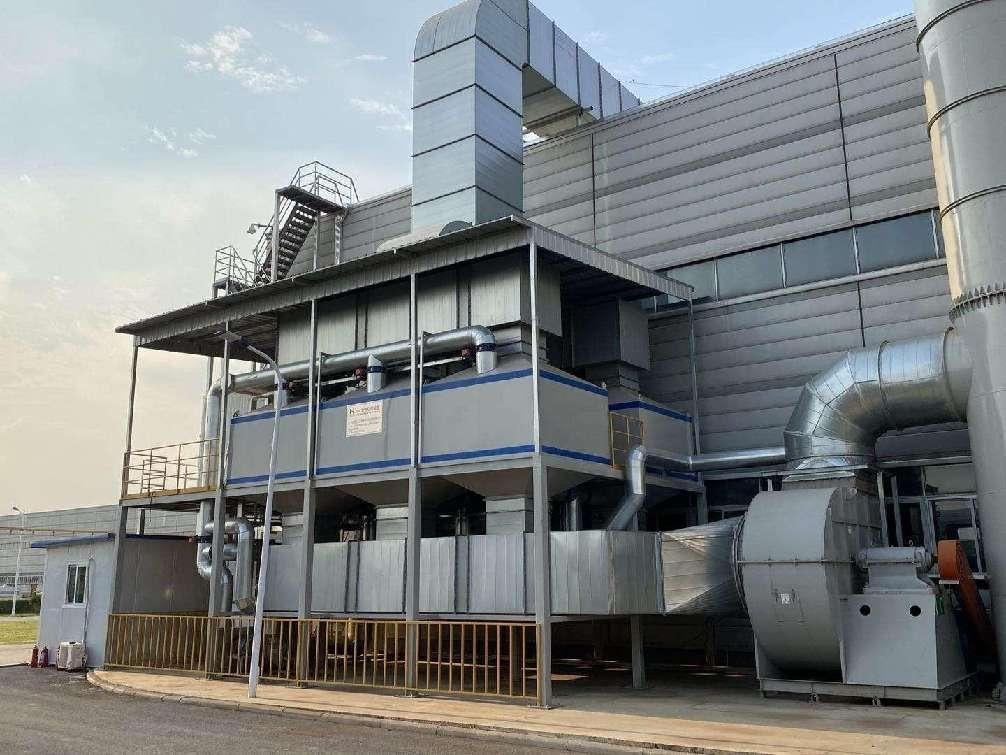
High-efficiency Purification Principle: Adopt the combined mode of pretreatment defogging + RTO thermal oxidation. The high-efficiency defogging device removes paint mist particles firstly, and then the RTO equipment thermally oxidizes and decomposes VOCs into CO₂ and H₂O at high temperature, ensuring the total purification efficiency ≥99% to realize deep waste gas purification.
Safety and Energy-saving Principle: The RTO equipment adopts a three-chamber heat storage structure with heat recovery efficiency ≥95%. The heat generated by VOCs combustion is used to preheat inlet gas to reduce energy consumption. The system is equipped with safety devices such as explosion-proof, explosion venting and nitrogen purging, combined with VOCs online concentration monitoring and automatic interlock control to completely eliminate potential safety hazards.
Production Adaptation Principle: The system air volume accurately matches the production capacity of the spraying line to meet the demand of multi-shift production and intermittent emission. The equipment is convenient for operation and maintenance with long regenerator replacement cycle. The service life of the main RTO equipment is ≥15 years, which fits the enterprise's long-term stable production plan.
4. Design Objectives
The purification efficiency of spray paint waste gas is ≥99%. After treatment, VOCs ≤30mg/m³, toluene + xylene ≤10mg/m³, particulate matter ≤5mg/m³ and oxygen content ≤10%. All indicators strictly comply with national and local environmental protection standards to ensure stable compliant exhaust emission and meet environmental information disclosure requirements.
A special exhaust funnel with a height of no less than 18 meters is constructed. Sampling platforms, monitoring holes and online monitoring equipment are arranged in accordance with specifications. Rainproof caps and flow measuring devices are installed at the outlet of the exhaust funnel to ensure high-altitude compliant discharge of waste gas.
The non-organized emission concentration of VOCs in the spraying workshop is controlled within the limit of GB 37822-2019 (non-methane total hydrocarbons ≤6mg/m³). The pungent odor is completely eliminated to improve the workshop operating environment, reduce the risk of employee occupational diseases and meet the requirements of safety production standardization.
The system realizes fully automatic operation and intelligent monitoring with functions such as VOCs concentration over-limit alarm, equipment fault self-diagnosis and emergency shutdown protection. The heat recovery efficiency is ≥95%, the annual energy consumption cost is reduced by more than 40%, and the annual stable operation time is ≥8500 hours to adapt to the enterprise's continuous production demand.
5. Spray Paint Waste Gas Treatment Process Design and Description
5.1 Process Selection Basis
Top-level purification efficiency: The RTO equipment oxidizes and decomposes VOCs into harmless CO₂ and H₂O at high temperature of 800-850℃. The degradation efficiency of benzene series, esters and other VOCs is ≥99%, which is much higher than activated carbon adsorption, catalytic combustion and other processes, ensuring the discharge concentration is steadily lower than strict standards.
Remarkable energy-saving benefit: The three-chamber heat storage structure can recover more than 95% of combustion heat for preheating untreated waste gas. Only a small amount of auxiliary fuel needs to be supplemented during normal operation, and even the temperature can be maintained by VOCs self-combustion, greatly reducing operating costs.
Comprehensive safety performance: The system is equipped with VOCs online concentration monitor (0-100%LEL). Fresh air dilution is automatically started when the concentration exceeds the standard. The equipment is provided with explosion-proof membrane, explosion vent and nitrogen purging system. The regenerator is made of high-temperature resistant and anti-corrosion materials to completely avoid explosion and equipment damage risks.
Enterprise development adaptation: The equipment processing air volume can be flexibly adjusted to meet the demand of future capacity expansion. It operates stably with long maintenance cycle. A small amount of waste residue generated can be centrally disposed, meeting the environmental compliance and sustainable development requirements of listed enterprises.
5.2 Process Flow
Supporting System: VOCs online monitoring system → Automatic control and early warning platform → Auxiliary combustion system → Nitrogen purging system → Waste heat recovery and utilization device
5.3 Detailed Process Description
Efficient source collection: Differentiated gas collection devices are set for spray booth and drying chamber. The spray booth adopts fully closed negative pressure gas collection with side suction air curtain to prevent waste gas overflow, and the wind speed is controlled at 0.8-1.0m/s. The drying chamber adopts a top gas collecting hood to ensure full collection of high-temperature waste gas. All waste gas is summarized through FRPP anti-corrosion pipelines, and the internal pipeline wind speed is maintained at 15-18m/s to avoid paint mist particle deposition and blockage.
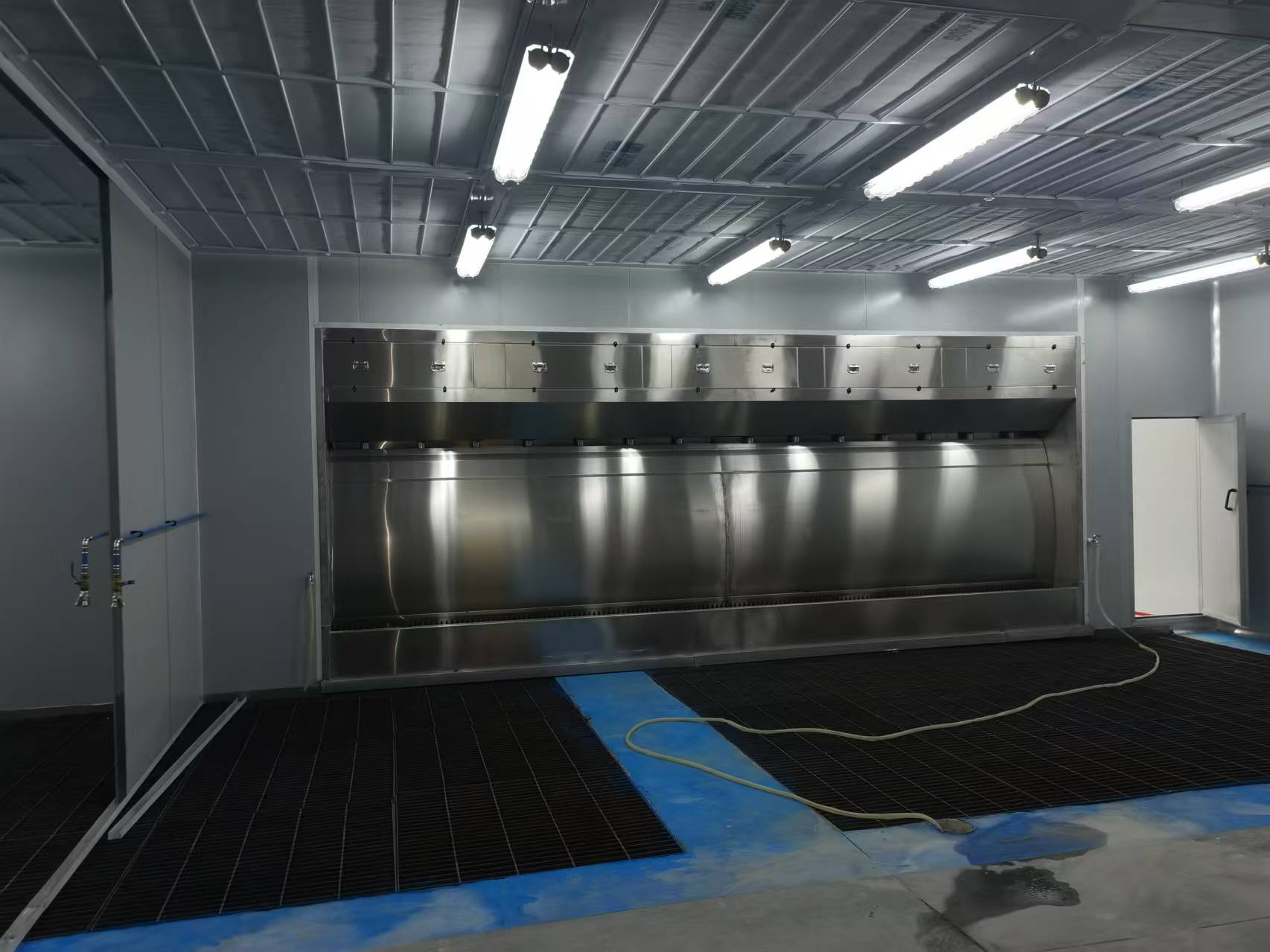
Pretreatment impurity removal: The waste gas firstly enters the water curtain cabinet, and more than 60% of large-diameter paint mist particles are captured by high-pressure water mist. Then residual paint mist is removed through primary filter cotton (filtration accuracy: 5μm), and deep defogging is completed by medium-efficiency filter cotton (filtration accuracy: 1μm) with defogging efficiency ≥99%. Finally, the activated carbon pre-adsorption layer removes part of sticky components that easily block the regenerator to protect the core RTO equipment.
Core RTO oxidation: The pretreated waste gas enters the three-chamber RTO equipment, and efficient treatment is realized through periodic switching of the heat storage chamber and oxidation chamber. In the first stage, the waste gas enters heat storage chamber A and is preheated to more than 700℃ by high-temperature regenerator. In the second stage, the preheated waste gas flows into the oxidation chamber. Under the action of high temperature of 800-850℃ and auxiliary burner, VOCs are completely oxidized and decomposed into CO₂ and H₂O. In the third stage, the purified high-temperature gas enters heat storage chamber B to release heat and heat the regenerator, then is discharged by the induced draft fan. Heat storage chamber C is purged and regenerated. The three-chamber circulation ensures the heat recovery efficiency ≥95%.
Safety monitoring and control: The system is equipped with 2 sets of VOCs online concentration monitors (one set at the inlet and one at the outlet) to monitor concentration changes in real time. When the inlet concentration ≥25%LEL, the fresh air dilution device is automatically started. The RTO equipment is built with temperature sensors and pressure sensors. Abnormal temperature or over-limit pressure will trigger an alarm immediately and start measures such as nitrogen purging and emergency shutdown. All electrical equipment adopts explosion-proof design to ensure operational safety.
Waste heat recovery and operation maintenance: The high-temperature waste heat generated by RTO equipment is recovered through heat exchangers for drying chamber heating or workshop heating, reducing natural gas consumption by more than 40% annually. System operation data is synchronously uploaded to the enterprise central control platform and environmental protection monitoring system to realize remote monitoring. The regenerator is inspected and maintained every 2 years. Activated carbon and filter cotton are replaced regularly according to operating load. Waste activated carbon is disposed by qualified institutions to form a closed-loop environmental protection system.
Entrusting Party: Guangdong Liuneng Technology Co., Ltd.
Consultation Hotline: 158-5314-5085