
 +86 15853145085
A high voltage electrostatic precipitator purifies flue gas by ionizing gas via high-voltage electrostatic field to charge dust particles, adsorbing charged particles onto collecting electrodes through electric field force, and finally collecting dust by ash cleaning system. Its operation includes four major procedures:
1. Corona Discharge (Gas Ionization)
The precipitator is equipped with discharge electrodes (cathode wires, mostly fine metal wires or needle-type electrodes) and collecting electrodes (grounded parallel metal anode plates). A high-voltage DC power supply (normally 40-75kV, even over 100kV) applies negative high voltage to discharge electrodes while collecting electrodes are grounded or positively charged, forming a strong electric field between two poles.
When electric field intensity reaches a certain level, corona discharge occurs around discharge electrodes to ionize ambient air, generating massive free electrons and negative ions to form ion cloud, which lays foundation for dust charging.
2. Dust Charging
After dust-laden airflow enters the electric field, dust particles collide with electrons and negative ions generated by ionization and get negatively charged. The charge capacity is determined by dust particle size, electric field intensity and residence time.
There are two main charging modes:
Field charging: Applicable to dust particles larger than 0.5μm; ions collide with dust under electric field force for charging.
Diffusion charging: Applicable to dust particles smaller than 0.2μm; ions attach to dust surfaces via thermal motion.
Most industrial dust is charged through the combination of the two modes.
3. Dust Sedimentation (Electric Field Adsorption)
Charged dust moves directionally towards oppositely charged collecting electrodes under electric field force F=qE (q stands for charge quantity, E for electric field intensity).
Dust releases electric charges upon reaching collecting electrodes and adheres steadily to plate surfaces by electric force and adhesion force. Purified gas is discharged from the outlet afterwards.
4. Ash Cleaning & Dust Collection
Accumulated dust layer on collecting electrodes will weaken electric field intensity and reduce dust removal efficiency, so regular ash cleaning is required. Common cleaning methods include mechanical rapping, acoustic cleaning and pulse jet cleaning.
Removed dust falls into the bottom ash hopper and is centrally collected and processed by ash conveying system, completing the whole dust removal process.
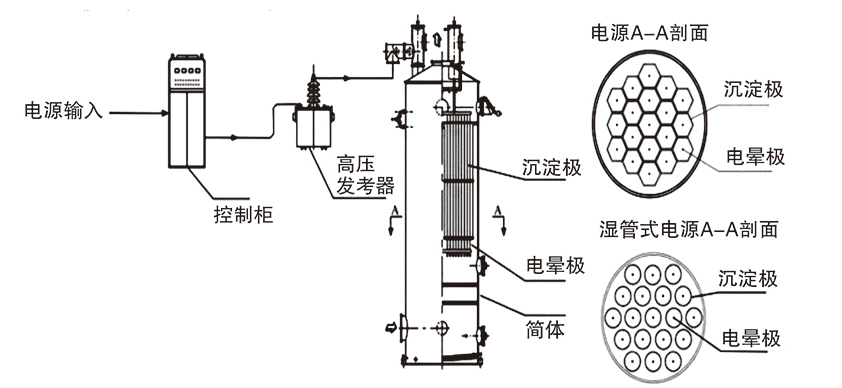
Key Structures & Influencing Factors
Core Structures
Electrode System
Discharge electrodes realize discharge and ionization, while collecting electrodes perform dust adsorption. Their shape, pole spacing and material directly determine electric field distribution and overall dust removal efficiency.
High Voltage Power Supply System
Composed of control cabinet, step-up transformer and rectifier, it supplies stable high-voltage DC power. Voltage stability is critical to purification performance.
Ash Cleaning System
Ensure long-term efficient operation and prevent electric field performance degradation caused by dust accumulation.
Airflow Distribution Device
Uniformly distribute dust-laden airflow inside the electric field and avoid insufficient dust charging and sedimentation caused by local excessive airflow velocity.
Factors Affecting Dust Removal Efficiency
Dust Properties
Particle size, specific resistance and concentration directly affect charging and sedimentation effect. High-resistivity dust tends to cause back corona and lower purification efficiency.
Electric Field Parameters
Reasonable electric field intensity, stable voltage and proper pole spacing guarantee favorable ionization and adsorption effect.
Airflow Velocity
Excessively fast airflow shortens dust residence time inside the electric field and hinders full charging and sedimentation. Air speed shall be regulated reasonably according to equipment specification and treated air volume.