
 +86 15853145085
Various countermeasures are available for VOCs treatment, including source reduction, intermediate control and terminal treatment. At present, terminal treatment dominates the waste gas management industry in China. Terminal treatment technologies are divided into destructive treatment and recovery treatment. Destructive treatment mainly includes catalytic combustion and thermal incineration. Recovery treatment includes absorption, condensation and adsorption. Due to immature technology and high operating cost, recovery treatment has not been widely applied on a large scale.
Thermal incineration directly sends VOCs into an incinerator for sufficient combustion to generate carbon dioxide and water. This method features low cost, wide application range and mature technical route. Catalytic combustion adds specific catalysts during organic gas combustion to reduce the ignition point of VOCs. Under catalytic action, VOCs are fully oxidized into carbon dioxide and water for standard discharge. Common catalysts are classified into non-precious metals such as Cu, Fe and Ti, and precious metals such as Pd, Au and Pt.
Thermal incineration and catalytic combustion occupy important positions in VOCs treatment due to thorough oxidation and high purification efficiency. Among them, catalytic combustion is widely used for low energy consumption, environmental friendliness and low oxidation temperature.
Catalytic combustion is a gas-solid heterogeneous chemical reaction belonging to deep oxidation reaction under aerobic conditions. The catalyst significantly reduces the activation energy of the chemical reaction. VOCs accumulate on the catalyst surface and perform flameless combustion at low temperature, decomposing into carbon dioxide and water while releasing massive heat.
With the action of catalysts, VOCs can be fully combusted at low temperature with a removal efficiency of 90%. Catalytic combustion has outstanding advantages such as low energy consumption, stable operation and zero secondary pollution. It has been widely applied in Western countries. In China, the application proportion of catalytic combustion in VOCs treatment reaches approximately 55%, making it one of the most mainstream purification technologies.
SRCO (Safety Regenerative Catalytic Oxidizer) decomposes VOCs into carbon dioxide and water at a low temperature of 200~400°C under catalytic effect. It is an efficient technology for organic gas purification and deodorization. SRCO is widely used for low-recycling-value waste gas in chemical industry, spraying, insulating materials, enameled wire production and coating manufacturing.
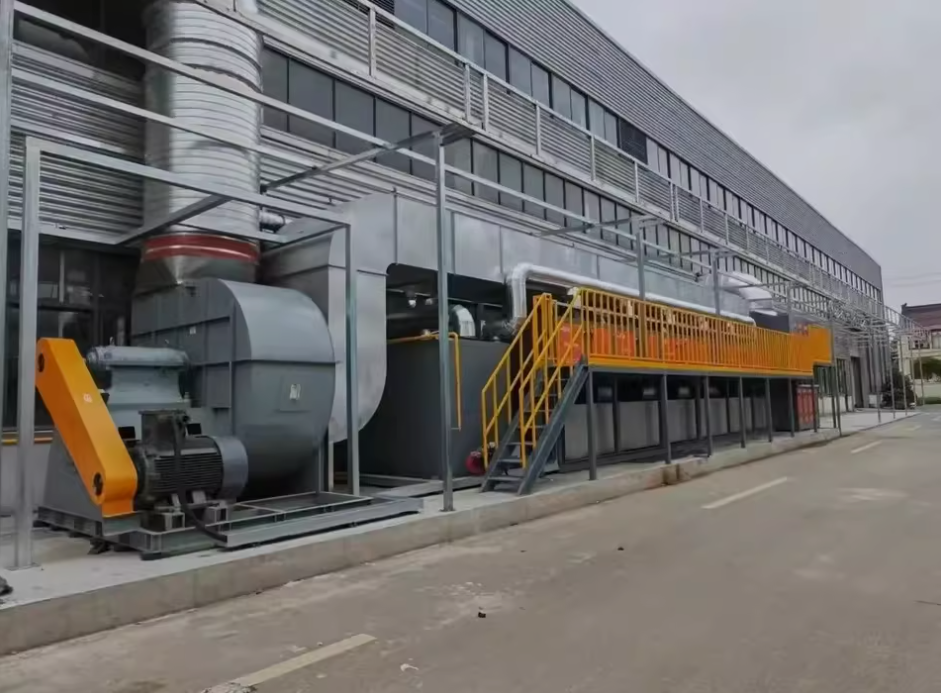
The SRCO catalytic decomposition device consists of pretreatment unit, preheating unit, catalytic combustion unit and explosion-proof unit. It effectively solves the common pain points of traditional environmental protection equipment:
① Safety optimization: Organic pollutants can be completely decomposed at 200-400°C, avoiding open-flame safety hazards existing in conventional TO, RTO and RCO incineration equipment;
② High purification efficiency: The removal efficiency exceeds 99%, solving the substandard emission problem of condensation, incineration, adsorption, plasma and photolysis technologies;
③ Low investment cost: The manufacturing cost of SRCO is only about 50% of traditional RTO equipment;
④ Low operating cost: Compared with adsorption equipment, SRCO requires extremely low energy consumption. It can realize self-heating circulation under the working condition above 1000 ppm without additional energy supply;
⑤ Intelligent maintenance: The whole system adopts PLC automatic control to realize intelligent adjustment according to real-time concentration and temperature changes.
As the core component of catalytic combustion equipment, high-quality catalysts must possess high activity, excellent thermal stability, high mechanical strength and long service life.
High activity: Catalyst activity directly determines chemical conversion efficiency. The conversion rate is affected by both active materials and carrier structure. Reasonable carrier shape and high-performance active substances are essential to ensure high purification efficiency.
Good thermal stability: Waste gas temperature fluctuates frequently. The catalyst must adapt to temperature variation to avoid performance degradation and efficiency reduction.
High mechanical strength: High temperature, vibration and airflow impact easily cause catalyst cracking and abrasion. Damaged catalysts will increase bed pressure drop and reduce purification performance.
Long service life: Most catalytic active metals are expensive. High-durability catalysts are selected to reduce replacement frequency and overall cost.
Optimized rare earth catalysts contain Sc, La, Ce, Pr and other rare earth elements. The synergistic effect of multiple active components increases acidic sites and oxide fluidity to enhance catalytic performance. With accessible raw materials and low cost, rare earth catalysts are highly suitable for industrial VOCs catalytic combustion. In addition, rare earth oxides feature long service life, excellent stability, strong regeneration capacity and diverse morphological forms.