
 +86 15853145085

 全国服务热线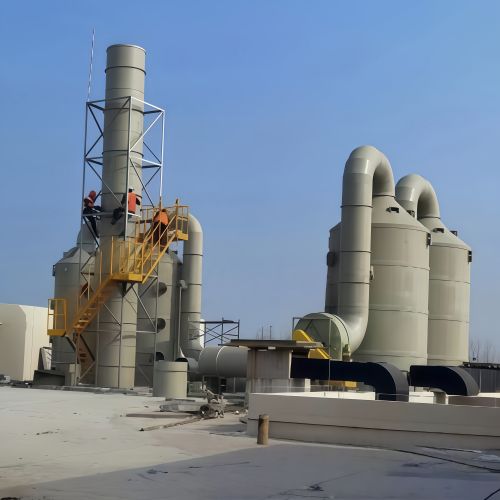
The spray tower purifies waste gas by contacting and absorbing pollutants or triggering chemical reactions between spray liquid and waste gas. As a common waste gas treatment equipment, it realizes neutralization reaction through atomized spray liquid or collects dust into the spray liquid.
Detailed Working Principle
1. Dust-containing gas and black smoke tail gas enter the bottom cone of the purification tower and are washed by water bath.
2. Part of dust particles combine with impact water mist and circulating spray water for sufficient mixing inside the tower.
3. Dust particles are captured by water. The dust-water mixture is separated by centrifugation or filtration, flows down along the tower wall into the circulation tank by gravity, and the purified gas is discharged outwards.
Structural Overview
The spray tower is structurally composed of one cyclone defogging layer, two spraying layers, three packing layers, three observation windows and five articulated ball valves. It has the advantages of high dust and desulfurization efficiency, small floor space, low water and power consumption, corrosion resistance, long service life, reliable operation and simple maintenance.
Design Specifications of Spray Tower
Spray tower design shall comply with general specifications in terms of structure, materials, process parameters and safety protection, with slight differences for different working conditions. The key universal specifications are as follows:
1. Structural Design
The tower body is generally cylindrical with a height-diameter ratio of 3:1 ~ 5:1 to ensure sufficient gas-liquid contact time. There are 2 to 3 spraying layers with a spacing of 1~2 meters, and nozzles are evenly distributed to cover the entire tower section. The packing layer height ranges from 1.5 to 3 meters with matched support plates. Baffles or cyclone plates are adopted for defogging to avoid entrained liquid droplets.
2. Material Selection
Corrosion resistance is the core requirement. PP spray towers are made of polypropylene with a temperature resistance range of -10℃ to 100℃. Nozzles and pipelines can adopt PP, PVDF or stainless steel. High-temperature resistant materials or cooling devices shall be equipped for high-temperature waste gas.
3. Process Parameters
The gas-liquid ratio is generally 1:10 ~ 1:20, and the liquid-gas ratio for odor treatment is 1~10 L/m³. The gas residence time inside the tower is 1~3 seconds, which shall be prolonged for chemical absorption working conditions. The pressure drop of the packing tower is controlled within 500~1500 Pa.
4. Safety Protection
Explosion-proof membranes and safety valves shall be installed for flammable and explosive gas. Sealing rings are used at interfaces to prevent leakage. Outdoor towers are equipped with stable supporting structures to avoid deformation and inclination.
Waste Gas Treatment Process of Spray Tower
The process principle is to collect waste gas through air hoods and deliver it to the spray tower by fan power. The gas contacts spray liquid in reverse flow to realize physical adsorption and chemical neutralization for pollutant removal.
Process Steps
1. Waste Gas Collection: Collect waste gas centrally through air collecting hoods.
2. Gas Delivery: Deliver waste gas continuously to purification equipment by induced draft fans.
3. Gas-liquid Contact: Waste gas enters the spray tower and is washed by acidic or alkaline spray liquid.
4. Neutralization Reaction: Odorous components fully contact with atomized liquid and complete neutralization reaction.
5. Gas-liquid Separation: The mist forms a porous treatment layer in the packing layer to further purify organic gas, and the liquid flows back to the water tank for recycling.
6. Discharge: Clean gas is discharged into the atmosphere through the fan.
This process is widely used in industrial waste gas treatment due to simple operation, high efficiency and low cost.
Operation Instructions and Operating Procedures of Spray Tower
1. Equipment Overview
The spray tower is an efficient waste gas purification equipment. It fully contacts spray liquid with waste gas to absorb or neutralize pollutants. It is widely used in chemical, electroplating and coating industries. Core components include tower body, spraying system, defogging layer, circulation water tank and fan.
2. Pre-operation Preparation
① Check the tightness of all connecting parts to ensure no leakage of pipes, valves and flanges.
② Supplement water to the standard liquid level and add corresponding absorbent such as alkaline liquid for acidic waste gas.
③ Inspect the power connection and operating status of spray pumps and fans to avoid abnormal noise and stagnation.
④ Clean internal sundries and dust on the defogging layer to ensure smooth airflow.
3. Operating Procedures
3.1 Startup Process
① Start the circulating water pump first, and turn on the induced draft fan after uniform spraying.
② Adjust fan air volume and pump flow to ensure sufficient gas-liquid contact.
③ Fine-tune absorbent concentration and spraying volume according to inlet and outlet gas concentration.
3.2 Operation Monitoring
① Check water level and reagent concentration every hour and replenish materials in time.
② Clean blocked nozzles immediately in case of uneven spraying.
③ Ensure fan current and pump pressure are within rated range and shut down for abnormalities.
④ Clean or replace the defogging layer in case of scaling and blockage.
3.3 Shutdown Process
① Turn off the induced draft fan firstly, then shut down the circulating pump after residual gas is discharged.
② Empty waste liquid and clean the water tank and spraying system to prevent scaling.
③ Cut off the main power and complete operation records.
4. Maintenance
Daily: Clean bottom sediments and check nozzle blockage.
Weekly: Clean defogging layer and inspect lubricating oil of fans and pumps.
Monthly: Check equipment tightness, replace aging seals and calibrate monitoring instruments.
Yearly: Carry out anti-corrosion treatment and overhaul fan impellers and motors.
5. Safety Precautions
① Operators shall wear protective gloves, masks and goggles.
② Do not open access doors during operation; cut off power before maintenance.
③ Store absorbents separately to avoid chemical reaction risks.
④ Inspect electrical insulation regularly; fans and pumps must be well grounded.
⑤ Shut down the equipment immediately and evacuate personnel in case of gas leakage.
Functions and Applications of Spray Tower
1. Core Functions
The spray tower removes pollutants through physical absorption and chemical neutralization to achieve compliant emission:
① Absorb acidic and alkaline gas such as HCl, SO₂ and NH₃ to reduce corrosivity.
② Capture dust and mist droplets to reduce atmospheric particulate pollution.
③ Remove partial VOCs and reduce odor diffusion.
2. Main Application Industries
Chemical Industry: Treat acidic tail gas, alkaline waste gas and organic volatile substances.
Electroplating Industry: Purify acid mist such as chromic acid mist and hydrochloric acid mist.
Coating Industry: Absorb paint mist and VOCs to reduce peculiar smell.
Metallurgical Industry: Desulfurization and dust removal of smelting flue gas.
Electronic Industry: Purify acidic waste gas generated by etching process.
Pharmaceutical Industry: Treat organic waste gas and corrosive gas.
Sewage Treatment Plant: Remove hydrogen sulfide, ammonia and other odorous gases.
Boiler Industry: Pre-desulfurization and dedusting for flue gas pretreatment.
Application Scope of Spray Tower
1. Applicable Pollutants
Acid and alkaline gas: Hydrochloric acid mist, sulfuric acid mist, nitrogen oxide, ammonia gas.
Particulate matter: Industrial dust, paint mist, smoke droplets.
Organic gas: Partial VOCs, hydrogen sulfide, methyl mercaptan and other odorous gases.
Other functions: High-temperature flue gas cooling and gas humidification.
2. Applicable Industries
Chemical industry, electroplating surface treatment, spraying and coating, metallurgy and steel, semiconductor electronics, pharmaceutical and pesticide, sewage treatment, energy boiler, printing and packaging, food processing industry.
Functions of Tower Packing Balls
Packing balls are core mass transfer components inside spray towers to strengthen gas-liquid contact and improve purification efficiency:
① Expand contact area: The porous structure increases the contact area between spray liquid and waste gas.
② Extend contact time: Disturb gas and liquid flow to prolong reaction time.
③ Uniform gas-liquid distribution: Avoid channel flow and wall flow for consistent treatment effect.
④ Improve mass transfer efficiency: Accelerate pollutant transfer from gas phase to liquid phase.
Common materials include polypropylene, polyethylene and ceramics, which shall be selected according to waste gas properties.
Hidden Danger Inspection Checklist for Spray Tower
Inspection Category | Inspection Item | Inspection Content | Standard Requirement | Result(Normal/Abnormal) | Abnormal Description | Rectification Measures | Person in Charge | Completion Time |
|---|---|---|---|---|---|---|---|---|
Tower Structure | Tower Appearance | Corrosion, deformation and leakage | No obvious corrosion, deformation or weld leakage | |||||
Access Door & Observation Window | Sealing performance and glass integrity | Well sealed without broken glass | ||||||
Internal Support | Loosening and falling off | Firm support without falling off | ||||||
Spraying System | Spray Pump | Noise, vibration and pressure | Stable operation with rated pressure | |||||
Spray Pipe | Blockage, damage and leakage | Smooth pipeline without leakage | ||||||
Spray Nozzle | Spraying effect and blockage | Uniform spraying without blockage | ||||||
Packing Layer | Collapse, scaling and blockage | Uniform packing without severe scaling | ||||||
Defogging System | Defogging Layer | Scaling, blockage and damage | No obvious scaling or damage | |||||
Outlet Droplet | Liquid entrainment condition | No obvious liquid droplet entrainment | ||||||
Circulation System | Circulation Water Tank | Water level, water quality and sediment | Standard water level with less sediment | |||||
Reagent Concentration | Absorbent concentration compliance | Meet process requirements with regular detection | ||||||
Pipeline & Valve | Blockage, leakage and flexibility | Smooth pipeline and flexible valves | ||||||
Fan System | Fan Operation | Noise, vibration and current | Stable operation with rated current | |||||
Fan Impeller | Dust accumulation and corrosion | Clean impeller without corrosion | ||||||
Air Duct Connection | Tightness and damage | Firm connection without air leakage | ||||||
Electrical System | Power Line | Insulation and aging condition | Good insulation without aging damage | |||||
Control Cabinet | Instrument display and wiring | Normal display and firm wiring | ||||||
Grounding Device | Grounding reliability | Qualified grounding resistance and firm connection | ||||||
Safety Protection | Protective Supplies | Completeness and validity | Complete and effective protective equipment | |||||
Warning Signs | Clarity and completeness | Complete and standardized signs | ||||||
Emergency Facilities | Passage and ventilation status | Smooth passage and available ventilation | ||||||
Others | Operation Record | Parameter and maintenance records | Complete, accurate and updated records | |||||
Surrounding Environment | Sundries and hidden dangers | Clean surroundings without flammable sundries |
Inspection Date: ____ Year ____ Month ____ Day Inspector: ____ Equipment No.: ____ Operating Status: □ Running □ Shutdown