
 +86 15853145085

 全国服务热线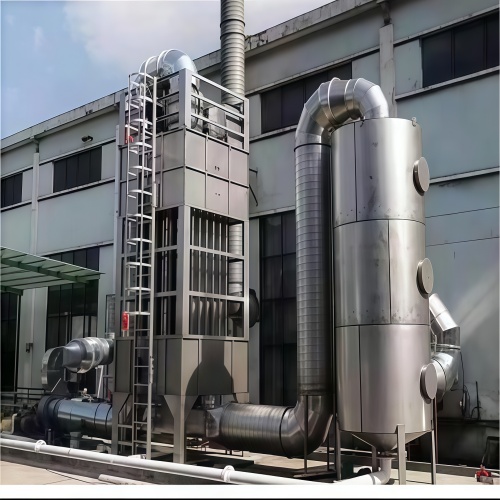
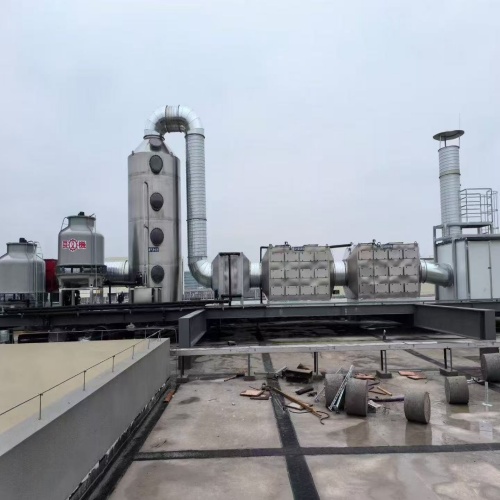
The spray tower is a commonly used purification scheme for industrial tar flue gas treatment. Its core principle is to realize the capture, washing and separation of tar through the contact between spray liquid and flue gas. Supporting processes can be equipped to further improve the purification effect. The specific process design, operation key points and precautions are as follows:
Ⅰ. Core Principle of Tar Flue Gas Treatment by Spray Tower
Tar in flue gas is mostly a liquid or semi-gaseous hydrocarbon mixture with certain viscosity and solubility.
Physical Washing
The spray liquid (such as water and special washing liquid) is atomized and sprayed from the top of the tower to form liquid droplets or liquid film. It is in full contact with the rising tar flue gas. Tar particles are adsorbed and condensed by liquid droplets, and then settle to the bottom of the tower along with the liquid phase.
Cooling Synergy
The temperature of tar flue gas is usually high (200~400℃). The spray liquid can reduce the flue gas temperature, condense gaseous tar into liquid state, and make it easier to be removed by washing.
Auxiliary Chemical Reaction
If it is necessary to remove impurities such as sulfides and nitrogen oxides in flue gas, alkali liquid (such as NaOH) and oxidants can be added into the spray liquid to realize integrated treatment of desulfurization, denitrification and tar removal.
Ⅱ. Process Design Key Points of Spray Tower
Structural Selection of Spray Tower
Packed spray tower is preferred: fill the tower with Pall rings, cascade rings and other fillers to increase the gas-liquid contact area and improve the tar removal efficiency (the removal rate can reach 80%~95%). For flue gas with high dust content, the combined structure of empty tower spraying + swirling plates can be adopted to avoid filler blockage and strengthen gas-liquid separation by swirling plates.
Selection of Spray Liquid
Type of Spray Liquid | Applicable Scenarios | Advantages and Disadvantages |
|---|---|---|
Clean water | Flue gas with low tar content and low viscosity | Low cost and easy to obtain; however, tar is easy to emulsify, resulting in difficult subsequent water treatment |
Special washing oil | High-concentration tar flue gas | Good compatibility with tar, high washing efficiency and recyclable tar; relatively high cost |
Alkali liquid (NaOH solution) | Tar flue gas containing sulfur-containing waste gas | Functions of tar removal and desulfurization; it is necessary to replenish alkali liquid regularly and control pH value |
Control of Key Parameters
Gas-liquid ratio: Generally controlled at 5~15 L/m³. Insufficient contact occurs if the ratio is too low, while excessive energy consumption and severe mist entrainment will be caused if the ratio is too high.
Spray pressure: The pressure of atomizing nozzle is controlled at 0.2~0.5 MPa to ensure fine droplet particle size (50~150μm) and improve contact efficiency.
Flue gas residence time: Ensure the flue gas stays in the tower for 3~8 seconds to avoid short flow phenomenon.
Ⅲ. Supporting Process and Post-Treatment
Pretreatment Unit
Tar flue gas is often entrained with dust. A cyclone dust collector or bag dust collector shall be installed in front of the spray tower to remove dust before entering the tower, so as to prevent nozzle and filler blockage.
Post-Treatment Unit
The flue gas at the outlet of the spray tower contains a large amount of water mist. Demisters (such as baffle demister and wire mesh demister) shall be installed to separate liquid droplets and avoid subsequent equipment corrosion. The tar-containing waste liquid at the bottom of the tower needs to recover tar through tar separators (such as gravity settling tank and centrifugal separator). The recovered tar can be reused in coking process to realize resource circulation.
Ⅳ. Operation and Maintenance Precautions
Regular cleaning: Clean nozzles and fillers regularly according to flue gas working conditions to prevent tar adhesion and blockage, generally once every 1~3 months.
Liquid level control: Keep the liquid level at the bottom of the tower stable. Excessively high liquid level causes mist entrainment, while excessively low liquid level fails to form a stable liquid seal.
Waste liquid treatment: Tar-containing waste liquid is prohibited from direct discharge. It can be discharged or reused only after reaching the standard through oil-water separation, biochemical treatment and other processes.
Ⅴ. Applicable Scope and Limitations
Applicable scenarios: Purification of medium and low concentration tar flue gas generated in coking plants, gas stations, asphalt mixing stations and other places.
Limitations: Limited removal efficiency for high-viscosity and high-concentration tar, which needs to be combined with electric tar catcher and other equipment. It is difficult to meet ultra-low emission standards when used alone, and multi-stage purification processes are required.
Selection of Tower Fillers in Tar Flue Gas Treatment by Spray Tower
In the process of tar flue gas treatment by spray tower, the core principles of filler selection are: increasing gas-liquid contact area, reducing tar adhesion and blockage risk, ensuring smooth gas-liquid flow, and taking into account temperature resistance, corrosion resistance and economy. The specific selection basis, recommended filler types and application precautions are as follows:
Ⅰ. Core Considerations for Filler Selection
Anti-blockage Capacity
Tar in flue gas has strong viscosity and is easy to adhere to the filler surface. Therefore, fillers with smooth surface, low adhesion and high void fraction are preferred to avoid rising tower resistance and decreasing treatment efficiency caused by tar accumulation.
Gas-Liquid Contact Efficiency
The filler shall have sufficient specific surface area (surface area per unit volume) to enable full contact between atomized spray liquid and tar flue gas, so as to promote tar adsorption and condensation.
Temperature and Corrosion Resistance
The temperature of tar flue gas is usually 150~400℃, and it may contain corrosive media such as sulfides. Thus, the filler shall have good high temperature resistance and corrosion resistance.
Pressure Drop and Flux
Select fillers with low pressure drop to reduce fan energy consumption. Meanwhile, ensure the filler flux (maximum allowable flue gas volume) meets the process requirements to avoid flue gas short flow.
Ⅱ. Recommended Filler Types and Applicable Scenarios
According to the characteristics of tar flue gas, annular fillers and grid fillers are preferred. The specific classification and comparison are as follows:
Filler Type | Representative Products | Recommended Material | Core Advantages | Applicable Scenarios |
|---|---|---|---|---|
Open-hole annular filler | Pall ring, cascade ring | PP (low temperature), stainless steel (medium and high temperature), ceramics (strong corrosion) | Smooth surface, high void fraction (>90%), strong anti-blockage capacity; large specific surface area for sufficient gas-liquid contact | Medium and low concentration tar flue gas (tar content < 500mg/m³), the preferred filler for tar flue gas spray tower |
Conjugate ring filler | Plastic conjugate ring, metal conjugate ring | PP, 304 stainless steel | Asymmetric structure, not easy to agglomerate; lower pressure drop and larger flux than Pall ring | Large flue gas volume and tar flue gas containing a small amount of dust, suitable for large-capacity treatment working conditions |
Grid filler | Plastic grid, metal grid | PP, carbon steel (anti-corrosion treatment) | Extremely high void fraction (>95%), minimal pressure drop and strong anti-blockage capacity | High-concentration and high-viscosity tar flue gas (tar content > 500mg/m³) or flue gas with high dust content |
Raschig ring filler | Ceramic Raschig ring, metal Raschig ring | Low cost and easy processing | Only applicable to working conditions with extremely low tar content and clean flue gas, not recommended as the main filler for tar flue gas |
Ⅲ. Filler Selection Suggestions for Different Working Conditions
Conventional Working Conditions (Medium and Low Temperature, Medium and Low Tar Concentration)
When flue gas temperature < 150℃ and tar content is 100~300mg/m³, PP material Pall ring / cascade ring is preferred, which has high cost performance and good anti-adhesion performance.
High Temperature Working Conditions (Flue Gas Temperature 200~400℃)
Stainless steel cascade ring / conjugate ring shall be selected for high temperature resistance and non-deformation. Meanwhile, tower body thermal insulation shall be carried out to avoid tar condensation and adhesion on the filler surface.
High Viscosity and High-Concentration Tar Working Conditions
When tar content > 300mg/m³ with high viscosity, grid filler is recommended. Its large gap structure is not easy to be blocked by tar, and segmented spraying (multi-layer spraying sections inside the tower) can be matched to strengthen the washing effect.
Working Conditions with Corrosive Media (such as H₂S)
Ceramic Pall ring or PP material conjugate ring is preferred for acid and alkali corrosion resistance to prevent filler damage caused by sulfide erosion.
Ⅳ. Precautions for Filler Application
Filling Method of Fillers
Random packing (annular filler) or regular packing (grid filler) is adopted to avoid excessive packing density causing high pressure drop. The packing height is generally 2~3 times of the tower diameter. Excessively high height increases resistance, while excessively low height leads to insufficient contact time.
Supporting Anti-Blockage Measures
Install pretreatment dust removal unit (cyclone dust removal) in front of the spray tower to reduce dust entering the tower; regularly backwash the filler with hot alkali liquid or washing oil to remove adhered tar. The backwashing cycle is determined according to the tar adhesion speed, generally once every 1~2 months.
Replacement Cycle
The replacement cycle of plastic filler is about 1~2 years, metal filler is about 3~5 years, and ceramic filler has a longer service life (5~8 years). The specific cycle shall be adjusted according to tar adhesion and corrosion degree under working conditions.