
 +86 15853145085
I. Measured Efficiency Comparison of Mainstream Material Spray Towers with Same Size & Working Conditions
| Spray Tower Type | Core Material Properties | Basic Treatment Efficiency | Efficiency Fluctuation Range | Efficiency Difference vs PP Empty Tower | Key Efficiency Influencing Factors |
|---|---|---|---|---|---|
| PP Empty Spray Tower | Lightweight, acid & alkali resistant, medium machining precision | ≥92% | 90%~95% | Benchmark (0) | Dead zones easily occur in nozzle layout for towers below 4m in diameter |
| PP Packed Spray Tower | Acid & alkali resistant, good packing layer compatibility | ≥95% | 93%~98% | +3%~+6% | Enhanced mass transfer via packing layer, no material-related efficiency loss |
| Carbon Steel Empty Spray Tower (Anti-corrosion Coated) | High rigidity, high machining precision, corrosion-resistant coating | ≥93% | 91%~96% | +1%~+3% | Customizable larger tower diameter, more uniform spray layer arrangement |
| Carbon Steel Packed Spray Tower (Anti-corrosion Coated) | High rigidity, excellent bearing capacity for packing layers | ≥96% | 94%~98% | +4%~+6% | High machining precision ensures thorough gas-liquid mixing without dead zones |
| FRP Empty Spray Tower | Corrosion-resistant, integrally molded, smooth surface | ≥92% | 90%~95% | 0 | Seamless integrated structure reduces wall flow yet limits nozzle installation accuracy |
| FRP Packed Spray Tower | Corrosion-resistant, lightweight, compatible with packing layers | ≥95% | 93%~98% | +3%~+6% | Smooth inner wall cuts down wall flow for slight mass transfer advantage |
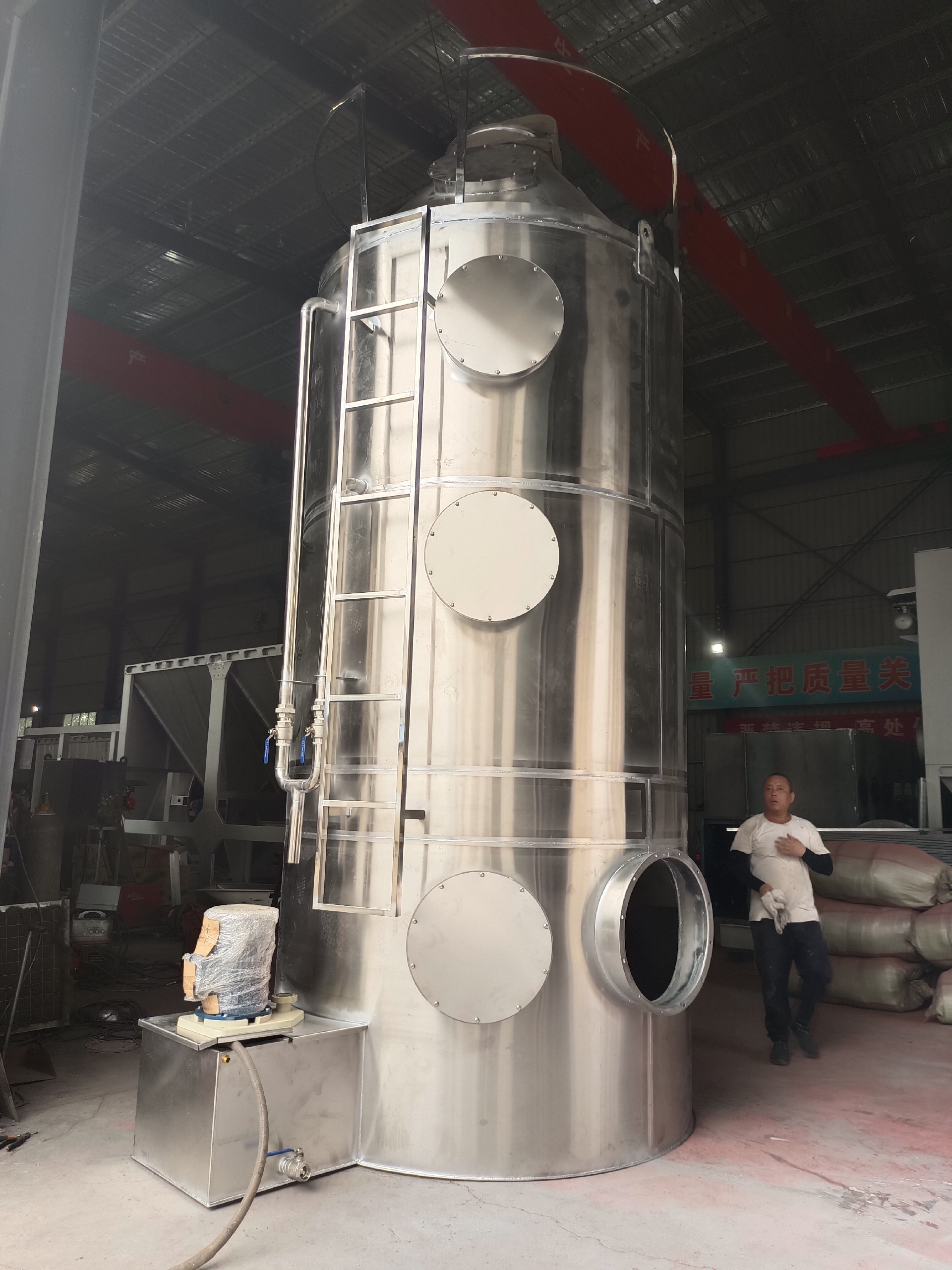
| 304/316L Stainless Steel Empty Spray Tower | Weak corrosion resistant, high rigidity & precision | ≥93% | 91%~96% | +1%~+3% | Suitable only for weakly corrosive waste gas, free from coating peeling risks |
| 316L Stainless Steel Packed Spray Tower | Moderate corrosion resistant, high precision, zero mass transfer loss | ≥96% | 94%~98% | +4%~+6% | No material-based design compromises, optimal overall efficiency |
II. Root Causes of Efficiency Differences Between Different Material Spray Towers (Non-material Factors)
- Machining Precision & Structural Design LimitationsCarbon steel and stainless steel feature high rigidity, enabling larger customized tower diameters and more evenly arranged spray layers (full nozzle coverage guaranteed even for towers over 5m in diameter).Free from assembly deformation and mixing dead zones, they achieve 1%~3% higher efficiency than PP and FRP towers.PP towers are assembled from plates and prone to slight deformation when diameter exceeds 3m, leading to partial dead zones in spray layout. The maximum single-tower diameter is limited to 4m; parallel connection of multiple towers for large air volume easily causes uneven airflow distribution and slight efficiency loss.FRP towers adopt seamless integral molding with smooth inner walls that reduce wall flow (spray liquid flowing along walls without contacting waste gas). However, manual molding results in lower precision of nozzle mounting holes, offsetting the wall flow advantage and keeping efficiency equal to PP towers.
- Long-term Operational Stability (Indirect Efficiency Impact)Uncoated or coating-peeled carbon steel towers are vulnerable to acid-base mist corrosion, causing inner wall scaling and perforation. This leads to airflow short-circuit and spray liquid leakage, resulting in a sharp efficiency drop of 10%~30% after 1~2 years of operation.PP, FRP and 316L stainless steel towers boast outstanding corrosion resistance with no scaling or corrosion issues. Their efficiency remains stable in long-term operation (efficiency decline below 5% within 3~5 years), requiring only regular replacement of nozzles and packing without material-related efficiency loss.304 stainless steel only resists weak acids and alkalis such as low-concentration ammonia water, and suffers pitting corrosion when exposed to concentrated acid mist, leading to gradual efficiency deterioration.
- Compatibility of Supporting ComponentsUnder severely corrosive conditions, PP and FRP towers are matched with plastic nozzles and corrosion-resistant circulating pumps. Well-matched accessories avoid nozzle blockage and deteriorated atomization caused by corrosion and shedding, maintaining stable efficiency.If metal nozzles are fitted on carbon steel towers for heavy corrosion scenarios, they tend to corrode and clog, worsening atomization and indirectly lowering efficiency. Equipped with plastic nozzles identical to those for PP towers, carbon steel towers deliver equivalent efficiency.
III. Core Performance Comparison of Spray Tower Materials (Excluding Efficiency)
| Material | Corrosion Resistance | Service Life (Year) | Machining Precision | Long-term Efficiency Stability | Maintenance Cost | Applicable Waste Gas Types |
|---|---|---|---|---|---|---|
| PP (Polypropylene) | Excellent acid & alkali resistance, poor high-temperature resistance | 5~8 | Medium | Excellent (decline<5%) | Low | Normal-temperature medium/high-concentration acid-base mist, water-soluble VOCs |
| Carbon Steel + Anti-corrosion Coating (Epoxy/PTFE) | Moderate acid & alkali resistance, prone to coating peeling | 3~5 (intact coating) | High | Poor (sharp drop after coating failure) | Medium | Normal-temperature low-concentration weakly corrosive & non-corrosive waste gas |
| FRP (Fiberglass Reinforced Plastic) | Excellent acid & alkali resistance, slight high-temperature resistance | 8~12 | Medium-high | Excellent (decline<3%) | Medium-low | Normal-temperature medium/high-concentration acid-base mist, outdoor-installed waste gas |
| 304 Stainless Steel | Weak acid & alkali resistance, intolerant to concentrated acid | 8~10 | High | Excellent (under weak corrosion) | Low | Low-concentration ammonia water, weak alkali mist, non-corrosive waste gas |
| 316L Stainless Steel | Moderate acid & alkali resistance, partial salt mist resistance | 10~15 | Extremely high | Optimal (decline<2%) | Low | Medium-concentration acid-base mist, waste gas containing trace salt mist |
| PTFE | Ultra-high corrosion resistance, wide temperature adaptability | 15~20 | Low | Excellent | High | Ultra-high-concentration strong acid mist, chlorine-based highly corrosive waste gas |
IV. Efficiency Correction for Spray Towers Under Non-standard Working Conditions
High-temperature waste gas (>60℃): PP towers have a temperature resistance limit of ≤60℃ and require pre-cooling to ambient temperature to prevent structural deformation and efficiency collapse. Carbon steel, FRP and stainless steel towers directly adapt to cooled waste gas with a unified correction coefficient of 0.8~0.85.
High-dust waste gas (dust content>50mg/m³): Pre-dedusting is mandatory for all material towers to prevent packing and nozzle clogging, with a unified correction coefficient of 0.7~0.8.
High-concentration waste gas (>200mg/m³): Extra spray layers and higher liquid-gas ratio are needed for all towers with a unified correction coefficient of 0.75~0.8. Benefiting from superior corrosion resistance, PP, FRP and 316L stainless steel towers stably support long-term chemical dosing spray treatment for high-concentration waste gas.
V. Core Selection Principles (Efficiency Priority + Working Condition Adaptation)
Efficiency-oriented selection: Prioritize anti-corrosion coated carbon steel or 316L stainless steel packed towers for high machining precision, uniform layout of spray and packing layers, stable long-term efficiency and zero material-related performance loss.
Severe corrosion working conditions: Rule out carbon steel towers and choose PP, FRP or 316L stainless steel towers. Material corrosion resistance guarantees sustained operational efficiency and avoids efficiency breakdown caused by corrosion.
Normal-temperature low/medium-concentration weakly corrosive waste gas: Select anti-corrosion coated carbon steel towers for cost-effectiveness and equivalent efficiency to stainless steel towers.
Outdoor installation & lightweight demand: Adopt integrally molded FRP towers with reliable corrosion resistance, same efficiency as PP towers and longer service life.
Ultra-high temperature & extreme corrosion scenarios: Choose 316L stainless steel or PTFE towers free from structural deformation and corrosion risks for steady efficiency.
VI. General Summary
Material does not equal efficiency: With identical design and working conditions, the basic efficiency gap among spray towers of different materials is within 5%. The 20%~30% efficiency advantage of packed towers over empty towers derives from tower type design rather than material differences.
Material determines efficiency stability: Towers made of poorly corrosion-resistant materials such as uncoated carbon steel suffer drastic efficiency decline in later operation due to corrosion and scaling, which belongs to operational maintenance divergence instead of initial efficiency disparity.
Process design outweighs material selection: A spray tower of any material with uneven spray arrangement, poor nozzle atomization or unreasonable packing structure will have 10%~20% lower efficiency than optimally designed towers of the same material, far exceeding material-based efficiency gaps.