 +86 15853145085

 全国服务热线
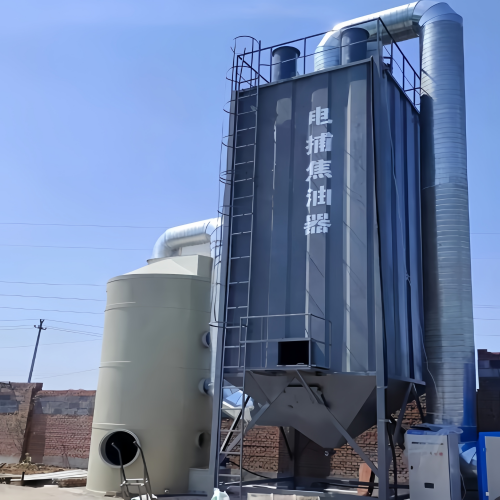
General introduction: The boiler flue gas electric tar precipitator, also known as electric dust precipitator, is an efficient purification equipment that uses a high-voltage electrostatic field to separate dust, tar droplets and fine particles from boiler flue gas. It is widely applied in flue gas treatment of coal-fired, oil-fired and biomass boilers, as well as coking and metallurgical industries.
Working Principle
Establishment of high-voltage electrostatic field: The equipment is equipped with cathode wires (discharge electrodes) and anode plates (dust and tar collecting electrodes). A strong electric field is formed around the cathode wires through a high-voltage DC power supply to ionize air into a large number of positive and negative ions.
Particle charging: After boiler flue gas enters the electric field, particles such as dust and tar droplets collide with ionized ions and absorb electric charges to become charged particles.
Charged particle collection: Under the action of electric field force, negatively charged particles move toward and adhere to the anode plates. If the electrode polarity is reversed, charged particles migrate to the corresponding electrodes.
Dust and tar cleaning: For dust, the anode plates are periodically knocked by rapping devices to make dust fall into the ash hopper for discharge. For tar droplets, tar attached to the plates flows down gradually by gravity and is discharged through the oil drainage device after collection.
Core Characteristics
High purification efficiency: The capture efficiency of fine particles (0.01~10μm) and tar droplets is over 95%, which effectively reduces flue gas blackness and pollutant emission.
Low pressure loss: The flue gas resistance is generally 100~300Pa, much lower than bag dust collectors, reducing the energy consumption of induced draft fans.
Low operating cost: No consumable materials except power consumption for electrode rapping and high-voltage power supply, achieving better long-term operating cost compared with bag dust collectors.
Strict applicable conditions: The suitable flue gas temperature is 90~150℃. Excessively high temperature reduces tar viscosity and adhesion capacity, while excessively low temperature causes tar condensation and electrode blockage. The dust concentration shall not exceed 30g/m³, and pre-treatment equipment such as cyclone dust collectors is required for high-dust flue gas.
Common Types
According to structural forms, boiler electric precipitators are divided into three types:
Concentric circle type: Cathode wires are arranged in concentric circles with cylindrical anodes. Suitable for medium and small flue gas with high tar content.
Tube type: Cathode wires are placed in the center of anode tubes with parallel multi-tube structure. Suitable for medium gas flow with excellent mist removal performance.
Plate type: Cathode wires and anode plates are arranged alternately. Suitable for large-flow boiler flue gas with high dust content.
Precautions
Explosion-proof requirement: Explosion-proof type is required for flue gas containing flammable and explosive gas such as coal gas and methane, equipped with nitrogen protection and explosion relief devices.
Insulation protection: Insulators shall be insulated and anti-condensation treated to prevent electric field short circuit caused by decreased insulation performance.
Regular maintenance: Regularly inspect cathode wire looseness and anode plate corrosion. Clean ash hoppers and oil drainage pipelines to avoid blockage.